
ASEAN Summit Manila 2026 Opens as Leaders Tackle Key Issues
By DunyaDesk · 2026-11-15
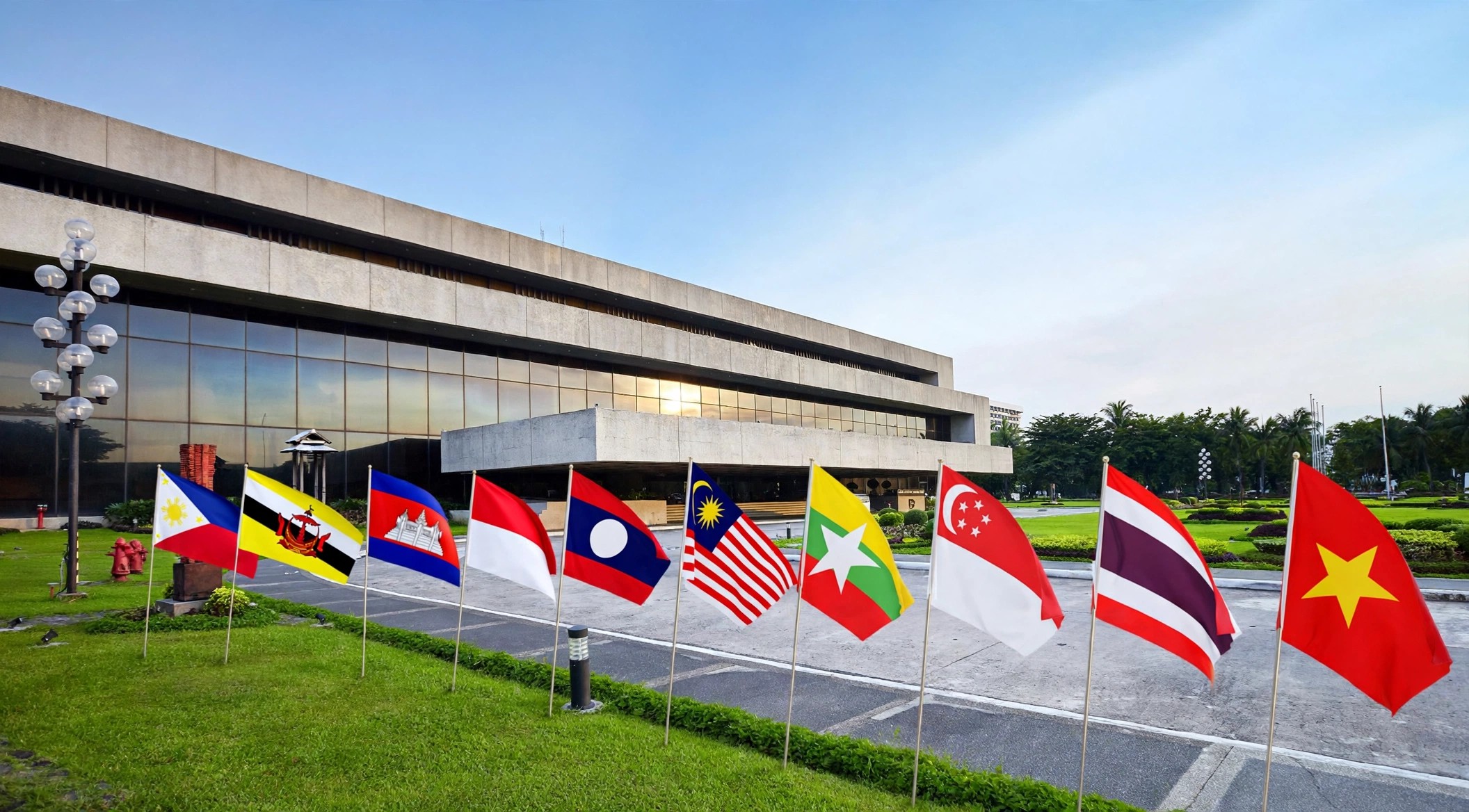
Southeast Asian leaders gathered in Manila on Sunday for the 49th ASEAN summit, opening three days of talks on regional security, economic resilience and geopolitical competition. The ASEAN summit Manila 2026 brings together the leaders of the 11-member bloc under the Philippines' chairmanship, with the South China Sea, Myanmar and trade high on the agenda.
The summit opened with a ceremony at the Philippine International Convention Center in Pasay City, followed by plenary and retreat sessions chaired by Philippine President Ferdinand Marcos Jr. Nine Southeast Asian leaders joined Marcos for the opening day, while Myanmar — sidelined from high-level meetings since the 2021 coup — was represented by the director-general of its foreign ministry's ASEAN affairs department.
Canadian Prime Minister Mark Carney, Brazilian President Luiz Inacio Lula da Silva and the International Monetary Fund joined the plenary as guests of the chair, according to Rappler.
South China Sea Code of Conduct in Focus
The South China Sea is expected to remain one of the summit's most closely watched issues, with ASEAN and China facing a year-end target to conclude negotiations on a Code of Conduct for the disputed waters.
The Philippines, this year's ASEAN chair, said on Thursday that China and ASEAN have agreed on about 70 per cent of the proposed Code of Conduct, but major issues remain unresolved — including the agreement's scope, its legal status and how it would be implemented.
Analysts, however, expect little progress on the toughest files. Andrew Mantong, ASEAN senior researcher at the Centre for Strategic and International Studies Indonesia, told CNA he expected "a well-run summit with solid economic results, but not much of a breakthrough on the tough political files", adding that a substantive, legally binding code was unlikely before the deadline and that at best talks may be described as "substantially concluded".
Joanne Lin, a senior fellow at the ISEAS-Yusof Ishak Institute in Singapore, agreed that the agreement was unlikely to be finalised either during the summit or by the end of 2026.
China claims sovereignty over most of the South China Sea, overlapping with claims by several Southeast Asian countries, including the Philippines, Vietnam, Malaysia and Brunei. The disputes have long tested ASEAN's ability to present a united position while maintaining relations with Beijing, the region's largest trading partner.
Myanmar's Crisis Still Unresolved
Myanmar remains another challenge for ASEAN, more than five years after the military seized power in a February 2021 coup. The bloc has continued to face questions over how to engage Myanmar's military authorities and whether its Five-Point Consensus, agreed in April 2021, has been implemented effectively.
The framework calls for an immediate cessation of violence, dialogue among all parties, humanitarian assistance and engagement through an ASEAN special envoy. Continued fighting and political divisions have complicated its implementation, while ASEAN continues to restrict Myanmar's political representation at its summits and foreign ministers' meetings.
International relations expert Teuku Rezasyah from the University of Padjadjaran said the summit should produce an "additional formula to better deal with Myanmar". Any decision to restore Myanmar's political representation at ASEAN's highest-level meetings would require consensus among member states.
Trade, Haze and the Chairmanship Handover
The gathering comes amid rising protectionism, uncertainty over global trade, and growing pressure on Southeast Asian countries to balance competing interests between Washington and Beijing. Lin of ISEAS said the meeting would carry "a strong focus on economic resilience, particularly amid growing protectionism, trade uncertainties and geopolitical tensions".
US President Donald Trump and Chinese Premier Li Qiang are among the prominent figures expected in Metro Manila, placing Southeast Asia at the centre of diplomatic attention ahead of the Asia-Pacific Economic Cooperation (APEC) Summit in Shenzhen, China, on 18 November. Trump is expected to arrive on 17 November for the ASEAN-US Special Summit, the last event of the three-day meeting. Chinese President Xi Jinping is not expected in Manila.
Another regional issue in focus is transboundary haze, with forest and land fires in Indonesia's Sumatra and Kalimantan regions sending smoke across borders and affecting Singapore and parts of Malaysia. ASEAN is working to establish a coordinating centre in Indonesia to strengthen efforts to prevent and respond to haze pollution, though slow ratification has hampered its establishment.
The Manila gathering also marks the end of the Philippines' ASEAN chairmanship, with Singapore taking over in 2027 as the bloc marks its 60th anniversary. The summit week also saw the signing of the world's first region-wide digital economy framework agreement.
Related summits with dialogue partners — Australia, China, India, Japan, New Zealand, South Korea, Russia, the United Nations and the United States — run from 16 to 17 November, and Marcos will also chair the 29th ASEAN Plus Three Summit with China, Japan and South Korea, and the 21st East Asia Summit, on the final day.
Sources: CNA, 14 Nov 2026; Rappler, 13 Nov 2026; Philstar, 11 Nov 2026; TV5, 11 Nov 2026.
Comments
No comments yet. Be the first to share your view.