
Baltit Fort Hunza: 700-Year-Old Palace Above Karimabad
By DunyaDesk · 2026-11-24
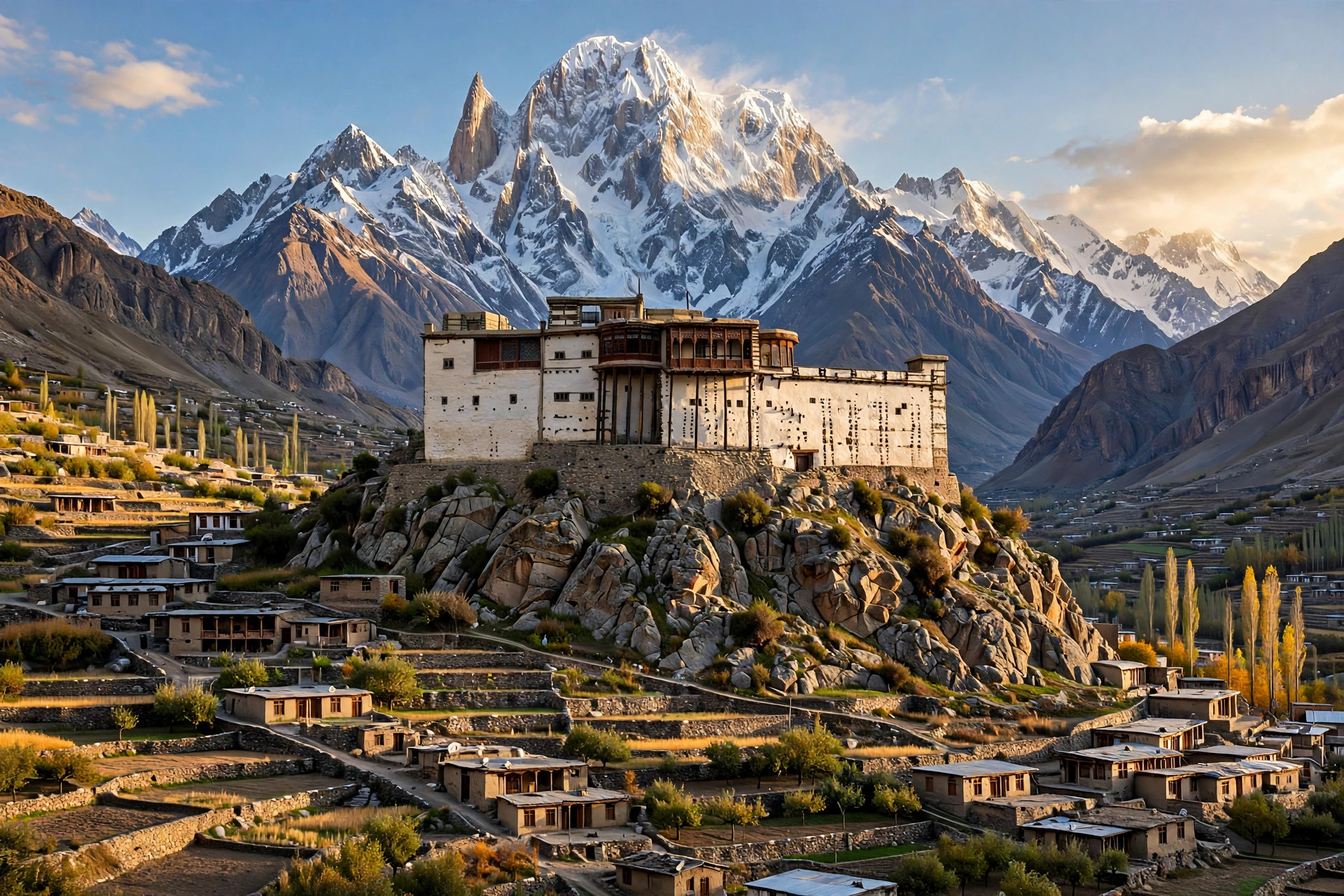
Baltit Fort Hunza has watched over Karimabad for more than 700 years. Its stone-and-timber halls, Tibetan-style design and mountain views make it the most visited monument in the valley.
Baltit Fort Hunza: A Palace Above the Clouds
Baltit Fort Hunza stands on a rocky spur above Karimabad, the main town of the Hunza Valley in Gilgit-Baltistan. For centuries it was the seat of the Mirs of Hunza, the rulers of this mountain principality. Today it is a museum and cultural centre, and the most visited monument in the valley.
Seven Centuries of History
The oldest part of Baltit Fort is a stone-and-timber defensive tower that conservation work has dated to about the 8th century CE, with some parts confirmed by carbon dating to the 13th century. The fort grew over the centuries as the Mirs added rooms and defences. In the 16th century, Mir Ayasho II married Shah Khatun, a princess from Skardu in Baltistan, and her family sent Balti craftsmen who rebuilt the fort. A cannon dated 1539 is said to have come as part of her dowry. The rulers first lived at nearby Altit Fort; after a quarrel between two sons of a ruler, one moved to Baltit, and it became the prime seat of power in Hunza.
Tibetan Style and the Potala Resemblance
The architecture of Baltit Fort shows strong Tibetan and Ladakhi influence, and visitors often compare its whitewashed walls and wooden balconies to the Potala Palace in Lhasa. The building is made of pegged timber frames filled with stone, a style that handles earthquakes better than rigid construction. Inside are carved wooden pillars, stained-glass windows, a central kitchen with a traditional fireplace, the Mir's bedroom with a carved door, and a roof terrace with views across the valley to Ultar Sar and Rakaposhi.
From Ruin to Museum
The Mirs of Hunza abandoned Baltit Fort in 1945 and moved to a new palace down the hill. The empty fort began to decay, and there were fears it might fall into ruin. After a survey by the Royal Geographical Society of London, the Aga Khan Trust for Culture led a restoration programme that was completed in 1996. The fort is now a museum run by the Baltit Heritage Trust, and the restoration won a UNESCO Asia-Pacific heritage conservation award in 2004. Baltit Fort has been on UNESCO's World Heritage Tentative List since 2004 — it is not yet a World Heritage Site.
Visiting Baltit Fort
Karimabad lies on a side road off the Karakoram Highway, about 100 km north of Gilgit, and is the usual base for Hunza. A stone staircase leads up to the fort's long wooden door. The museum rooms display Hunza life and history, but the building itself is the main exhibit. The roof terrace is one of the best viewpoints in the valley, with Ultar Peak towering above the fort. The lanes of old Karimabad below the fort, and Altit Fort a short drive away, complete the visit.
Sources: Wikipedia, Structurae, MIT AKPIA (Aga Khan Program for Islamic Architecture), trek.pk, Graana.
Comments
No comments yet. Be the first to share your view.