
Faisal Mosque Islamabad: Pakistan's Iconic Marble Marvel
By DunyaDesk · 2026-11-27
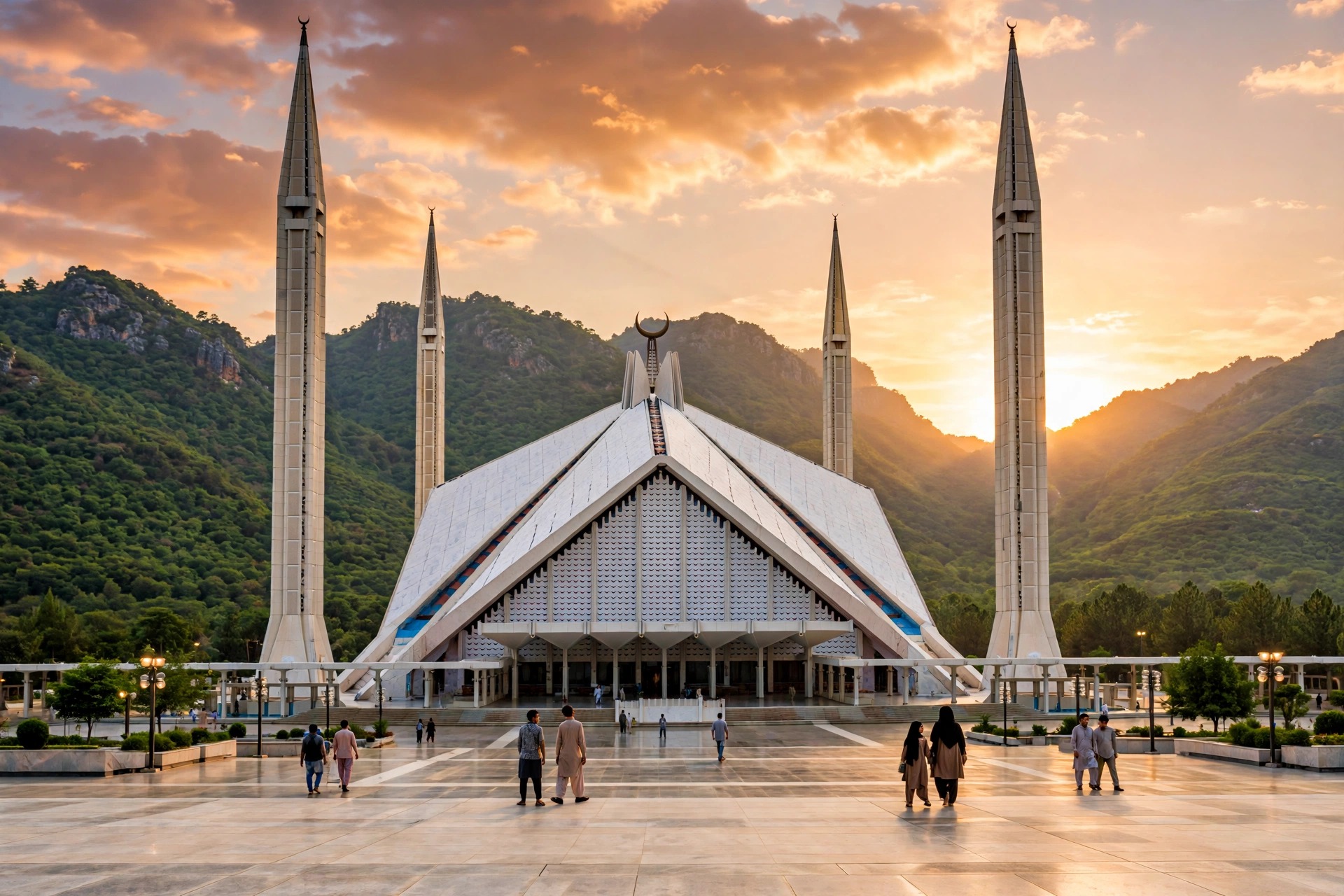
Faisal Mosque Islamabad rises at the foot of the Margalla Hills like a white tent pitched against a green mountain — the first sight that tells a visitor they have truly arrived in the capital.
It is Pakistan's national mosque, and unlike almost any other great mosque in the world, it has no dome at all. Instead, its eight-sided concrete shell slopes upward in great triangular slabs of white marble, shaped like a Bedouin tent, framed by four slender minarets. On a clear evening, when the hills turn dark and the mosque glows against them, the whole city seems to pause and look.
A gift named for a king
The story of Faisal Mosque Islamabad begins in 1966, when King Faisal of Saudi Arabia visited Pakistan. The idea of a grand national mosque took hold, and the Saudi government funded its construction. An international competition was held, and the winning design came from Turkish architect Vedat Dalokay — a plan so different from the domed mosques of the Mughal and Ottoman tradition that it surprised everyone.
Construction began in 1976 and the mosque was completed in 1986. King Faisal had died in 1975 and never saw the finished building, but it carries his name to this day — and so does the avenue that leads up to it. The first prayer was held in June 1988.
The largest mosque in the world — for seven years
When it was completed, Faisal Mosque was the largest mosque in the world, a title it held until 1993. The main prayer hall alone holds around 10,000 worshippers, and with its porticoes, courtyards and surrounding grounds, the complex can hold close to 300,000 people at a time.
The hall itself is a marvel of open space: an octagonal, pillar-less room where nothing blocks the view, roofed by eight triangular slabs. Around it, the grounds spread over roughly 33 acres, with courtyards, an ablution area, a women's prayer hall, and a library and museum.
What it feels like to stand there
Ask anyone who has visited, and they will not talk about the numbers first. They will talk about the feeling — the cool marble underfoot, the hush inside the great hall, and the view from the courtyard where the whole of Islamabad spreads out below.
Families come here on weekends, children run across the wide marble courtyard, and photographers wait for sunset, when the white tent turns gold and then silver under the lights. From Daman-e-Koh, the viewpoint terrace high on the Margalla Hills above, you can look down on the mosque and the grid of the city at once — the postcard view of Islamabad.
A symbol of the capital
Faisal Mosque is more than a building. It is the symbol of Islamabad itself — the image on postcards, travel guides and every visitor's camera roll. It stands for the friendship between Pakistan and Saudi Arabia, for a modern Pakistan confident enough to build something entirely new, and for the quiet pride of a city that grew up around it.
If you ever visit Islamabad, go in the late afternoon. Climb the steps as the sun drops behind the hills, listen to the call to prayer echo across the courtyard, and watch the white marble catch the last light. It is a sight you will not forget.
Source: Wikipedia, Dunya News, Arab News Pakistan, Graana, DailyLife.pk
Comments
No comments yet. Be the first to share your view.