
Hingol National Park: Pakistan's Largest National Park, Mud Volcanoes and the Princess of Hope
By DunyaDesk · 2026-11-16
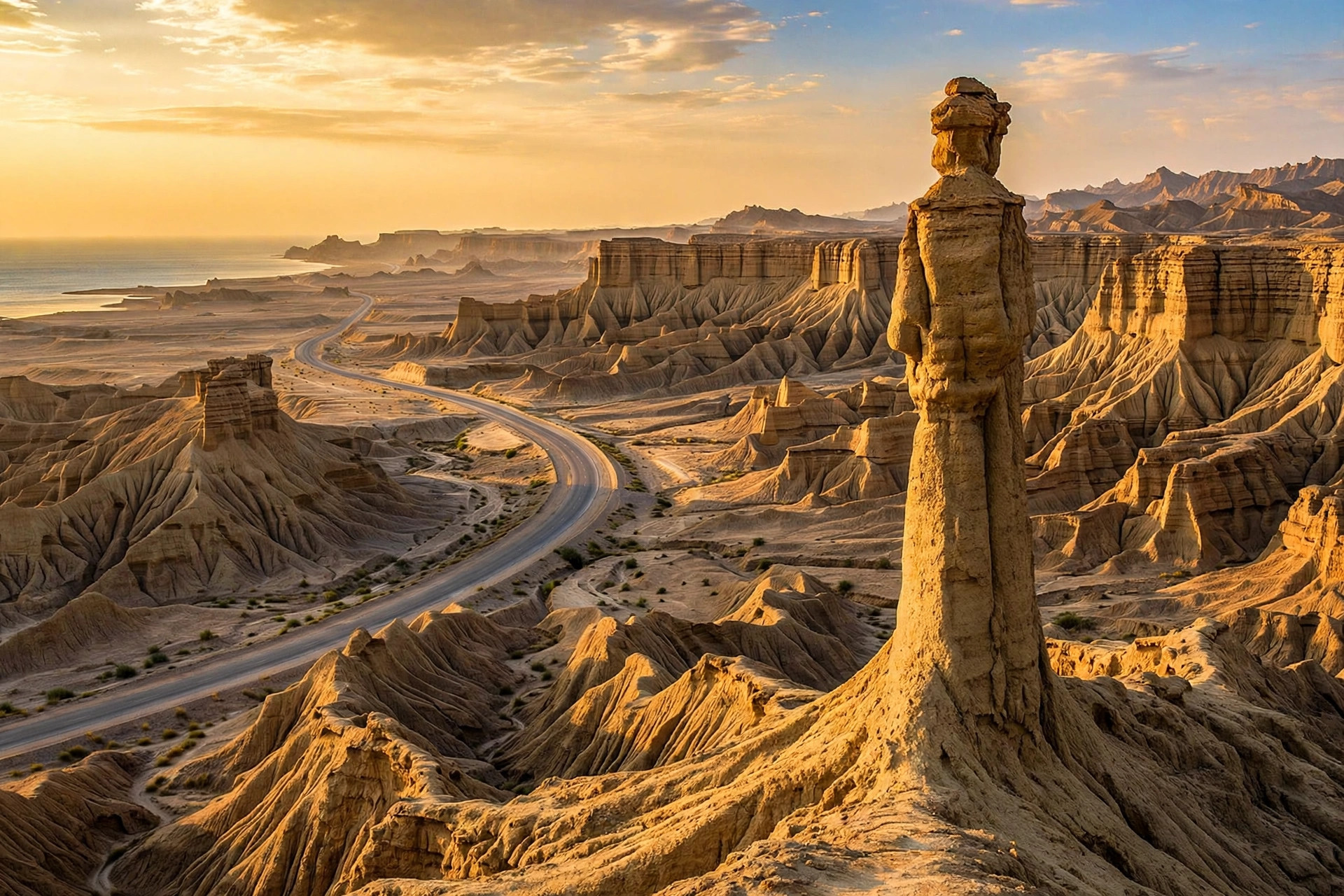
Hingol National Park is Pakistan's largest national park, covering about 6,100 square kilometres of the Makran coast in Balochistan, where the Hingol River meets the Arabian Sea. Declared a national park in 1988, it stretches across the districts of Lasbela, Gwadar and Awaran, around 190 kilometres west of Karachi along the Makran Coastal Highway. It is a place where desert, river, sea and mountains meet — and where wind and water have carved the soft mudstone into shapes that look almost sculpted by hand.
The park takes its name from the Hingol River, which flows through its gorges and forms an estuary before emptying into the Arabian Sea. The river's valley holds patches of arid subtropical forest, while the coast offers empty beaches and the river mouth shelters marsh crocodiles. Since the Makran Coastal Highway was completed in 2004, the park's strange rock formations have drawn travellers from across the country.
Hingol National Park: The Princess of Hope and the Sphinx
The most famous landmark in Hingol National Park is the Princess of Hope, a tall, slender hoodoo of eroded mudstone near the Buzi Pass section of the highway that resembles a woman gazing into the distance. Its popular name is credited to Hollywood actress Angelina Jolie, who is said to have named it during a visit to Pakistan in 2004 — a story guides repeat, though it remains anecdotal. The formation itself is entirely natural, shaped by wind and rain over thousands of years.
Beside it stands another weathered ridge that looks strikingly like a crouching sphinx, sometimes called the Balochistan Sphinx or the Lion of Balochistan. Together, the two formations have become the park's signature image — the first thing most travellers photograph on the Makran coast.
Mud Volcanoes That Bubble Without Fire
Hingol is also famous for its mud volcanoes, among the rarest geological features in the world. The volcanoes range in height from 243 to 457 metres, mostly in the Mid-Hor area, and UNESCO's tentative-list entry says they occur in about ten clusters around Hingol and Hinglaj. There is no lava: gas trapped deep in the sediments forces watery mud up through fissures, building grey cones that bubble and hiss.
The best known is Chandragup, a steep grey cone whose crater bubbles with mud and gas. It is sacred to the Hindu community — pilgrims climb it to make an offering before continuing to the Hinglaj Mata shrine. Visitors are warned not to step into the crater: the mud is deep and unstable.
Hinglaj Mata and the Coast
Deep in the river gorge sits the Hinglaj Mata temple, a cave shrine that is one of the most important Hindu pilgrimage sites in Pakistan. Each year, the Hinglaj Yatra brings thousands of pilgrims through the park to the shrine, stopping at the Chandragup mud volcano on the way. The whole cultural landscape — temple, volcanoes, river and coast — was placed on UNESCO's Tentative List in 2016, a first step towards any future World Heritage nomination; it is not yet an inscribed site.
Beyond the shrine, the park's coast offers Kund Malir Beach, a long stretch of golden sand where the desert meets the sea, and the Hingol estuary, home to marsh crocodiles. Wildlife in the park includes the Sindh ibex, urial and chinkara gazelle, which survive in the rugged hills and dry valleys.
Visiting Hingol
Hingol lies about a three-hour drive from Karachi on the Makran Coastal Highway, and most visitors come as a day trip or an overnight stop on the way to Gwadar. The best time to visit is the cooler months, when the desert heat eases and the light turns the mud mountains gold. Travellers should check current local advice before setting out, as conditions in parts of Balochistan can change.
For Pakistanis who have only seen the north's green valleys, Hingol is a reminder that the country's beauty is not one landscape but many — a lunar desert on the edge of the sea, carved by wind, watched over by a princess of stone.
Sources: Wikipedia, DailyLife.pk, UNESCO World Heritage Centre (Tentative List), RealPakistan, Guide to Pakistan.
Comments
No comments yet. Be the first to share your view.