
Katas Raj Temples: Pakistan's Sacred Pond of Shiva's Tears
By DunyaDesk · 2026-11-23
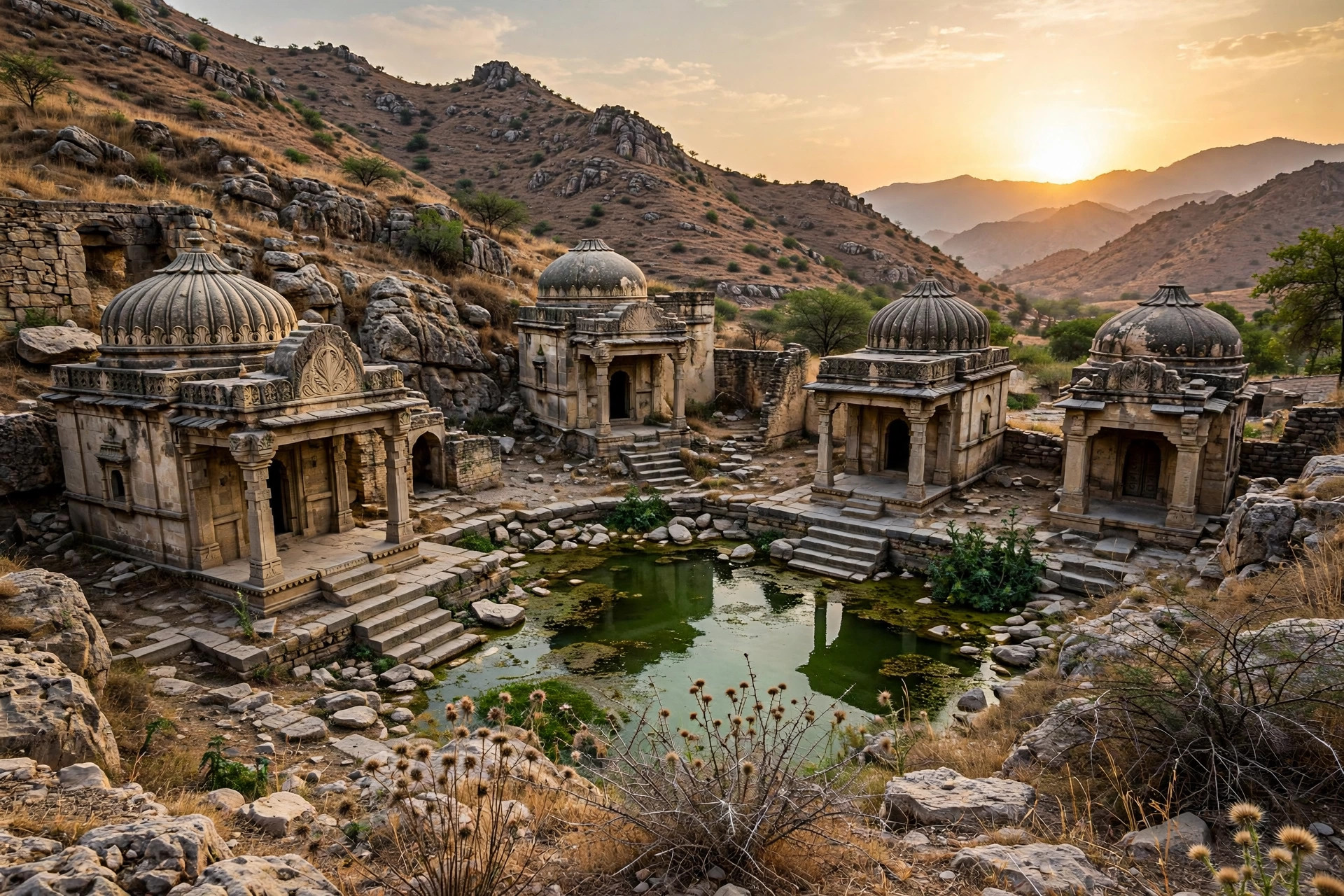
The Katas Raj Temples in Chakwal are among the most remarkable heritage sites in Pakistan — a cluster of ancient Hindu temples wrapped around a sacred green pond in the dry hills of the Salt Range, and a place that still draws pilgrims and travellers from far beyond Punjab. For readers following Pakistan news about the country's ancient history, Katas Raj is one of the finest examples of how deep that history runs.
The temples stand near the town of Choa Saidanshah, close to Kallar Kahar and the M2 Motorway, about 90 kilometres south-east of Islamabad, at an altitude of 2,000 feet. Seven temples make up the complex, connected by walkways, with the pond at their heart. The site is also known as Qila Katas, and its name is believed to come from the Sanskrit word kataksha, meaning tearful eyes.
The sacred pond of Katas Raj Temples
The pond is the soul of the place. Hindu tradition, recorded in the Puranas, says it was created from the tears of the god Shiva, who wandered the Earth inconsolable after the death of his wife Sati. The pond covers an area of two kanals and 15 marlas, with a maximum depth of 20 feet, and in Urdu and Persian it is called Chashm-e-Alam — the eye of the world. Hindus regard its water as sacred, and a bath in it is believed to wash away sins.
The temples are considered the second most sacred Hindu site in historic Punjab. Before the Partition of 1947, Katas Raj was a well-known pilgrimage site, with large numbers of Hindus visiting for the festival of Maha Shivaratri. Pilgrims still come twice a year, most of all in February for Maha Shivaratri and again in November and December — many of them travelling from India and other countries.
Katas Raj Temples and the Mahabharata
Hindu tradition also links Katas Raj to the Mahabharata, the great epic in which the Pandava brothers are believed to have spent a large part of their 12-year exile on these lands. The highest point of the complex, now called Satghara, is traditionally believed to be the land of Dvaitavana from the epic — the place where the brothers faced the riddle contest with the Yakshas, known as the Yaksha Prashna. Another tradition says the god Krishna laid the foundation of the temple and set up a hand-made lingam there.
The history that can be documented is old enough on its own. The Chinese monk Faxian described a temple at Katas Raj in his travel writings in the 4th century CE, and the Chinese traveller Xuanzang visited the area in the 7th century. The oldest surviving temple dates back to the 6th century CE, and the Shahi dynasties built Hindu temples here from the mid 7th to 10th centuries. The founder of Sikhism, Guru Nanak, is also believed to have visited the site, which became a popular destination for ascetics.
A site that fell silent, then came back
After Partition, the temples fell into disrepair and suffered decades of neglect. In 2005 Pakistan proposed restoring the complex, and in 2006 a restoration project began — cleaning the sacred pond, painting and repairing some temples, and putting up information boards around the site. In January 2017 the government began installing shikharas, the tall spires, on the temples. In 2025, Pakistan issued visas to 154 Indian Hindu pilgrims to visit Katas Raj dham.
The sacred pond itself has been in trouble for years. Where it once stood more than seven feet deep, its natural springs were reportedly blocked by heavy use of underground water by cement plants in the area. A lawsuit led the Supreme Court to fine the cement plant owners heavily for exploiting the water reserves — and today the pond is filled through tube wells.
Katas Raj sits inside the Salt Range, a landscape of dry, rocky hills that has yielded prehistoric axes, granite knives, terracotta bangles and pottery. For a visitor, the reward is simple: ancient stone temples, a green pond in the middle of barren hills, and a silence that carries more than fourteen centuries of history. It is a reminder that Pakistan's heritage is not only its forts and mosques — it is also this quiet, sacred corner of Chakwal, waiting to be seen.
Sources: Wikipedia, The News, Global Political Review.
Comments
No comments yet. Be the first to share your view.