
Lahore Smog: Punjab's Pollution Squad Battles Stubble Fires
By DunyaDesk · 2026-11-14
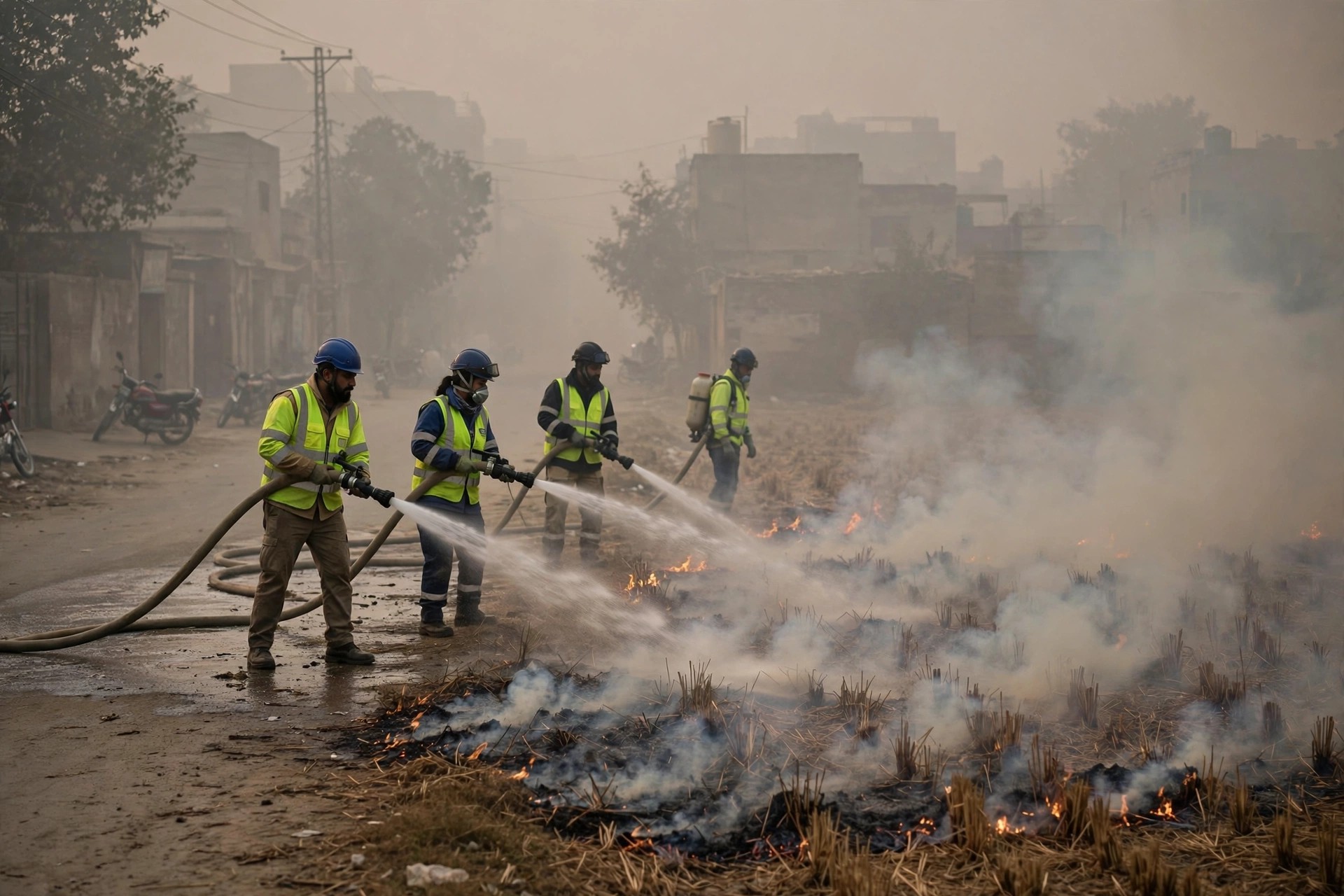
Lahore smog returned with force on Saturday as the city's air quality index hit 244 in the morning, and Punjab's new 750-member Environmental Protection Force raced to douse the stubble fires officials blame for much of the winter haze.
On Thursday, officers of a new quick-response unit swung off their vehicles at a paddy field on the edge of Lahore, Reuters reported. Smoke curled low over the stubble, and the crew had the fire under control within minutes, keeping it from adding to the haze over a city that Swiss group IQAir rated "very unhealthy" earlier this week. By midday on Saturday the live reading had eased to 154, still in the "Unhealthy" range with PM2.5 as the primary pollutant, according to weather.com.
Lahore Smog: The New Pollution Squad
The unit is the first of its kind in Pakistan dedicated to fighting pollution, officials say, and it is one of the most visible steps in a campaign that Punjab officials claim is working. Silwat Saeed, chief of the Environment Protection and Climate Change Department in Punjab, said the government this year formed a 750-member force in 67 rapid-response units across the province's main rice-growing districts.
Teams aim to reach a reported field fire within 10 to 15 minutes, and they also patrol paddy areas for signs of burning. Complaints can be lodged locally through multiple channels, said Ashfaq Hussain, a deputy director of the force. "We receive complaints through multiple channels and respond to them in the shortest possible time," he said. In a single 24-hour period this week, the department received 679 field fire reports from across Punjab and said it extinguished 650 of them.
Stubble Burning and the Fines
Farmers in the region commonly set leftover rice residue alight after the October harvest, fuelling a toxic mix of industrial emissions, vehicle exhaust and construction dust that lingers under cold winter air, driving pollution to hazardous levels. The crackdown pairs enforcement with machinery: violators face fines, arrest or both.
Farmers caught burning stubble face fines of 15,000 Pakistani rupees ($54) per acre, said Muhammad Farooq, an assistant director of the Punjab Agriculture Department. Those who fail to pay the fines can also face prosecution and a possible jail term of up to six months. The government has also distributed more than 10,000 subsidised super seeders, paying 60% of their cost while farmers pay the remaining 40%.
Muhammad Ismail, who farms 50 acres, said switching from stubble burning to a subsidised super seeder and other machinery had significantly boosted his wheat yield per acre. Yet adoption is far from universal. Saleem Abbas, another local farmer who has shifted away from stubble burning, said many still favour the practice because it is widely regarded as the cheapest and fastest way to clear fields for the next crop.
Lahore's Wider Anti-Smog Crackdown
The stubble-fire squads are only one part of a wider enforcement drive. The Commissioner of Lahore has ordered a strict, zero-tolerance crackdown against smog violators across the division, The Nation reported on 13 November. Since 1 October, enforcement teams have inspected 3,435 industrial units, 2,245 brick kilns and 1,711 restaurants across the Lahore Division.
Due to violations, 97 cases were registered and fines totalling 12.6 million rupees were imposed, while 25 FIRs were registered and fines of 375,000 rupees were imposed for burning crop residue. There is a complete ban on open waste burning — including trash, tyres and garden waste — and on the use of substandard fuel, and joint squads are monitoring smoke-emitting vehicles and enforcing covers on transport trolleys. Brick kilns in the division have moved to zigzag technology, and the Commissioner said the rice harvesting process is nearing completion, with a zero-tolerance policy on burning crop residue.
Is the Campaign Working?
Satellites have detected less burned area in India and Pakistan than the historical average at this point in the year, Reuters reported, even as many locals in Pakistan say they struggle to notice improvements. In recent days, patients have crowded benches and corridors at local hospitals in Lahore. Abdullah Nayyar, director general of the Punjab Environment Protection Department, said health department data show smog-related throat hospitalizations last month were only at 69% of the level recorded in October 2025.
But at Lahore's Sir Ganga Ram Hospital, Ahmed Abubakar, a heart patient who has had a bypass and is diabetic, said smog had brought on breathing problems and eye infections. Mohammad Niaz Butt, who said his nose and throat blocked up, put it bluntly: "They are burning it, and nothing is done about it." Over recent years, Pakistan and India have each accused the other of worsening the air. Saeed said the challenge is huge for both countries and that Pakistan has raised it with officials from India at international forums. India's foreign ministry did not respond to a request for comment.
For Lahore's residents, the test of the new force will be simple: whether the grey haze over the city thins as winter sets in, or whether the annual smog season follows its usual course despite the squads, the fines and the subsidised machines.
Sources: Reuters, 14 Nov 2026; The Thursday Times, 14 Nov 2026; The Nation, 13 Nov 2026; Arab News, 14 Nov 2026; weather.com (live AQI reading, 14 Nov 2026).
Comments
No comments yet. Be the first to share your view.