
Multan City of Saints: Shrines, Blue Pottery and Mangoes of Pakistan's Sufi Heartland
By DunyaDesk · 2026-11-12
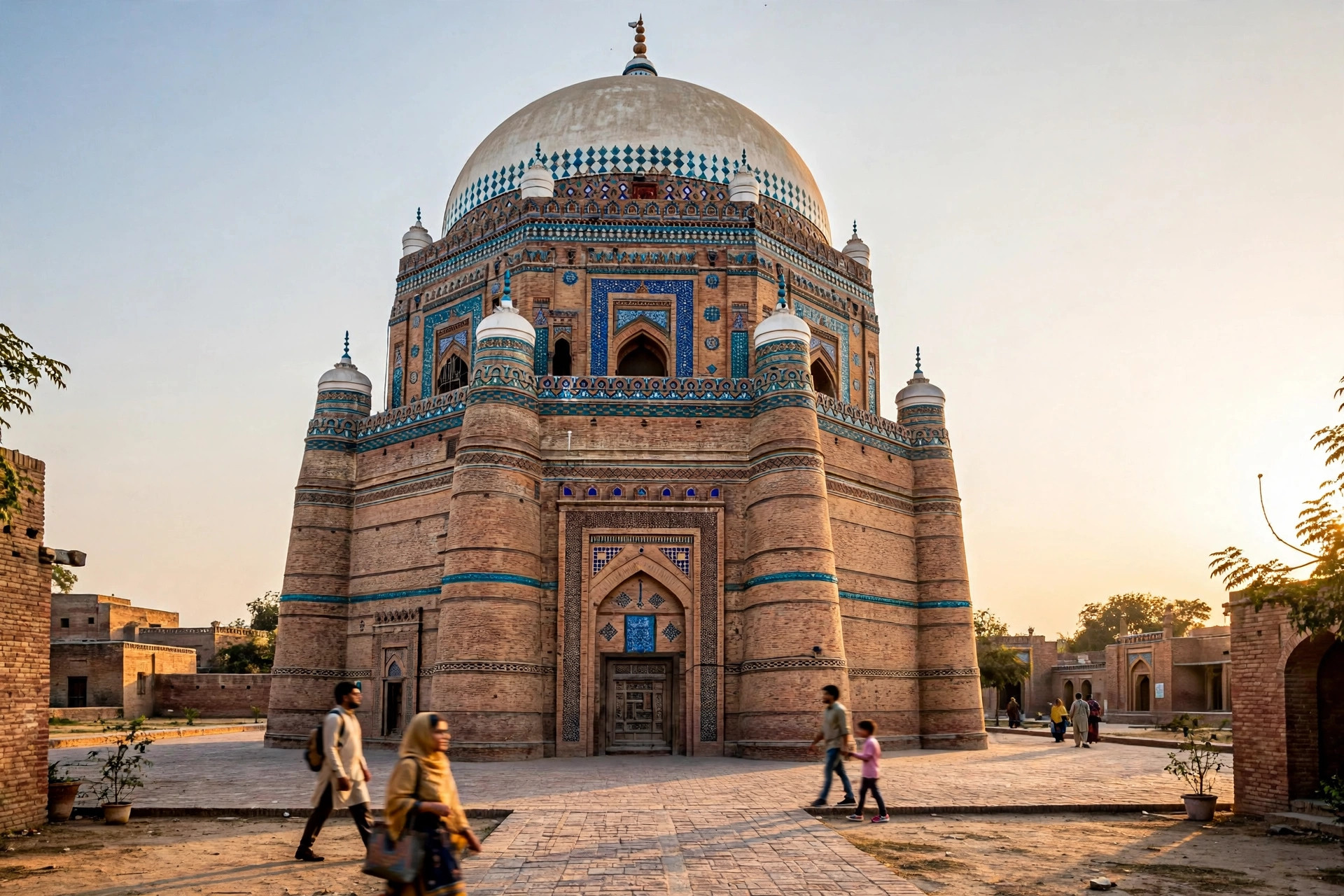
The Multan City of Saints is the city that Pakistanis visit with their hearts first. Tucked into southern Punjab on the eastern bank of the Chenab River, Multan is a centuries-old city of Sufi shrines, blue-tiled tombs, hand-painted pottery and the sweetest mangoes in the country. It was once also called the City of Gold — and for anyone searching for the best places to visit in Multan, the answer begins with its saints. The best time to visit Multan is between November and March, when the weather is mild; summers here are extremely hot, with June highs regularly above 42°C.
Multan City of Saints: Why the City of Saints Draws Travellers
Multan earned its name from the sheer number of Sufi shrines packed into its old city — the tombs of saints who settled here centuries ago and whose shrines still draw visitors from across Pakistan every day. The city grew around its fort mound and walled old city, and its bazaars, shrines and pottery workshops have kept the same rhythms for generations. For travellers, Multan is not a one-day stop: it is a city to walk slowly, shrine by shrine, bazaar by bazaar, tasting as you go.
Shah Rukn-e-Alam and Bahauddin Zakariya: The Great Shrines of Multan
The greatest of Multan's shrines is the tomb of Shah Rukn-e-Alam, grandson and successor of Bahauddin Zakariya. Built between 1320 and 1324, it is a celebrated example of Tughlaq architecture — octagonal, covered in blue and white glazed tilework — and it stands on Pakistan's UNESCO World Heritage tentative list. It rises on the south-west side of the old fort mound, visible from across the city. Bahauddin Zakariya himself was a 13th-century Sufi saint of the Suhrawardiyya order who settled in Multan in 1222; his mausoleum stands at the north-eastern edge of the old Multan Fort, and was almost completely ruined during the British siege of Multan in 1848 before being restored. Other famous shrines include that of Shah Shams Sabzwari, a 13th-century saint whose mausoleum stands on the high bank of the old Ravi riverbed near Aam Khas Bagh; Shah Yusuf Gardez, whose shrine sits just inside Bohar Gate in the walled city; and Bibi Pak Daman, mother of Shah Rukn-e-Alam.
Multan Blue Pottery and the Old Walled City
The same blue tiles that cover Multan's shrines are the city's most famous craft. Multan's blue pottery — cobalt blue, turquoise and white glazed ceramics — is called Kashigari, from kashi (tile) and kari (work), and its roots lie in Persian and Central Asian traditions. The earliest datable glazed-tile monuments in Multan are its 13th-century shrines, and shrine-repair work kept the craft alive for centuries; the Punjab Small Industries Corporation set up the Institute of Blue Pottery Development in Multan in 1985 to revive it. Above the old city stands Multan Fort — Qila Kohna — whose walls were reported 40 to 70 feet high and about 6,800 feet in circumference, with 46 bastions and four gates; only Qasim Gate survives today, the rest destroyed in the fighting of 1818 and 1848–49. The old walled city had six gates — Lohari, Bohar, Haram, Pak, Delhi and Dolat — and its present wall dates to 1756. The Ghanta Ghar clock tower, built from 1884 to 1888 in Indo-Saracenic style and originally called Northbrook Tower, still marks the heart of the old city; its clocks, stopped since 1985, were repaired and restarted on 27 October 2011. Hussain Agahi Bazaar, the commercial heart of the old city, is where visitors find textiles, jewellery, street food, blue pottery and embroidered khussas.
Multan Mangoes and Sohan Halwa: The Taste of Multan
Multan is widely called Pakistan's mango capital, and with good reason. Chaunsa — Pakistan's most famous mango — originates from Multan: a late-season mango, available from July to September, sweet and fibreless, with a custard-like flesh. Anwar Ratol, small and intensely aromatic, grows in Multan and Bahawalpur in June to August, and Langra is also grown around the city. Multan hosts a Mango Festival every July. And no visit to Multan is complete without Sohan Halwa, the city's defining sweet, made from flour, milk, sugar, ghee and nuts — so closely tied to the city that, as Dawn once put it, Multan and Sohan Halwa have become synonymous. Its origin is told in several competing legends, so it is best enjoyed as legend — the taste, happily, is entirely real.
Sources: Punjab Government Multan portal; Wikipedia (Mausoleums of Multan, Shah Rukn-e-Alam, Clock Tower Multan, City Wall of Multan); Dawn, 12 Jan 2015; Mosafir; Laure Wanders; Guide to Pakistan; Zartash; MMA Farms; TripAdvisor.
Comments
No comments yet. Be the first to share your view.