
Derawar Fort: The Forty-Bastion Desert Fortress Rising from Cholistan's Golden Sands
By DunyaDesk · 2026-11-10
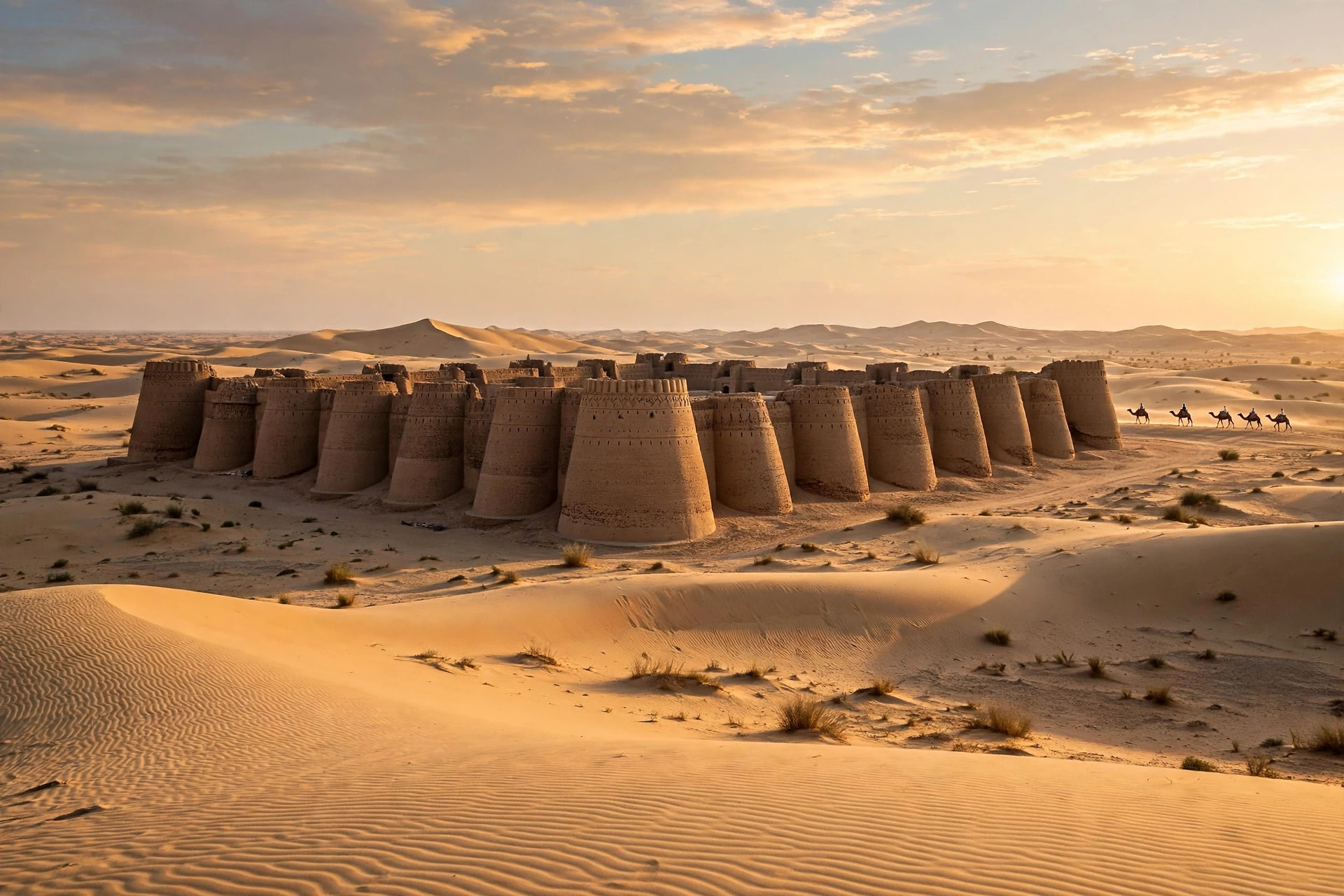
The Derawar Fort Cholistan rises out of the golden sands of the Rohi desert like a mirage: a massive square fortress of baked clay bricks, ringed by forty towering bastions that can be seen from miles away across the empty dunes. Standing about 130 kilometres south of Bahawalpur in Punjab, Derawar is the best surviving of the medieval desert forts of Cholistan — a place where Rajput kings, Abbasi Nawabs and desert caravans all left their mark.
Derawar Fort History: From the 9th Century to the Nawabs of Bahawalpur
Derawar Fort was first built in the 9th century, in about 858 CE, by Rai Jajja Bhatti, a Rajput ruler of the Bhatti clan, as a tribute to Rawal Deoraj Bhatti of Jaisalmer. The fort later passed to the Abbasi Nawabs of Bahawalpur: Nawab Sadeq Mohammad Khan I captured it in 1733 and rebuilt it in the grand form that stands today. The Nawabs lost it briefly in 1747, took it back in 1804, and kept it as their desert stronghold and residence until the 1970s. It is this unbroken occupation that saved Derawar while most of the other desert forts around it crumbled away.
Forty Bastions: Why Derawar Fort Looks So Powerful
The most famous feature of Derawar Fort is its forty circular bastions — ten on each side — each standing about 30 metres high. The fort's walls run for about 1,500 metres around a square, and also rise up to 30 metres. Built entirely of local baked bricks, the fortress blends with the desert around it, and on a clear evening its bastions glow golden in the setting sun. The fort guarded the old caravan routes that crossed Cholistan, and the dry bed of the ancient Hakra River nearby once watered a whole civilisation — the Indus Valley culture flourished here thousands of years ago.
Derawar Fort Today: UNESCO List and the Cholistan Desert
In April 2016, the Government of Pakistan placed "Derawar and the Desert Forts of Cholistan" on UNESCO's Tentative List for World Heritage status — an early step towards a possible World Heritage nomination. The Cholistan Desert, locally called Rohi, spreads across some 26,000 square kilometres and was once dotted with around forty desert forts; Derawar is the finest survivor. The fort remains in the private ownership of the Bahawalpur royal family, so visitors need prior written permission from the current Nawab to enter the fort and the royal graveyard nearby. Conservation work has continued in recent years, with the Punjab Archaeology Department spending on repairs to the bastions, the main gate and the internal mosque. For travellers, the best time to see Derawar is the cool winter season, when the desert light is soft, the camel caravans pass by, and the great fort stands exactly as it has for centuries — silent, golden and unforgettable.
Sources: UNESCO World Heritage Centre, Wikipedia, bahawalpur.org
Comments
No comments yet. Be the first to share your view.