
Makli Necropolis: The Silent City of a Million Tombs Near Thatta
By DunyaDesk · 2026-11-10
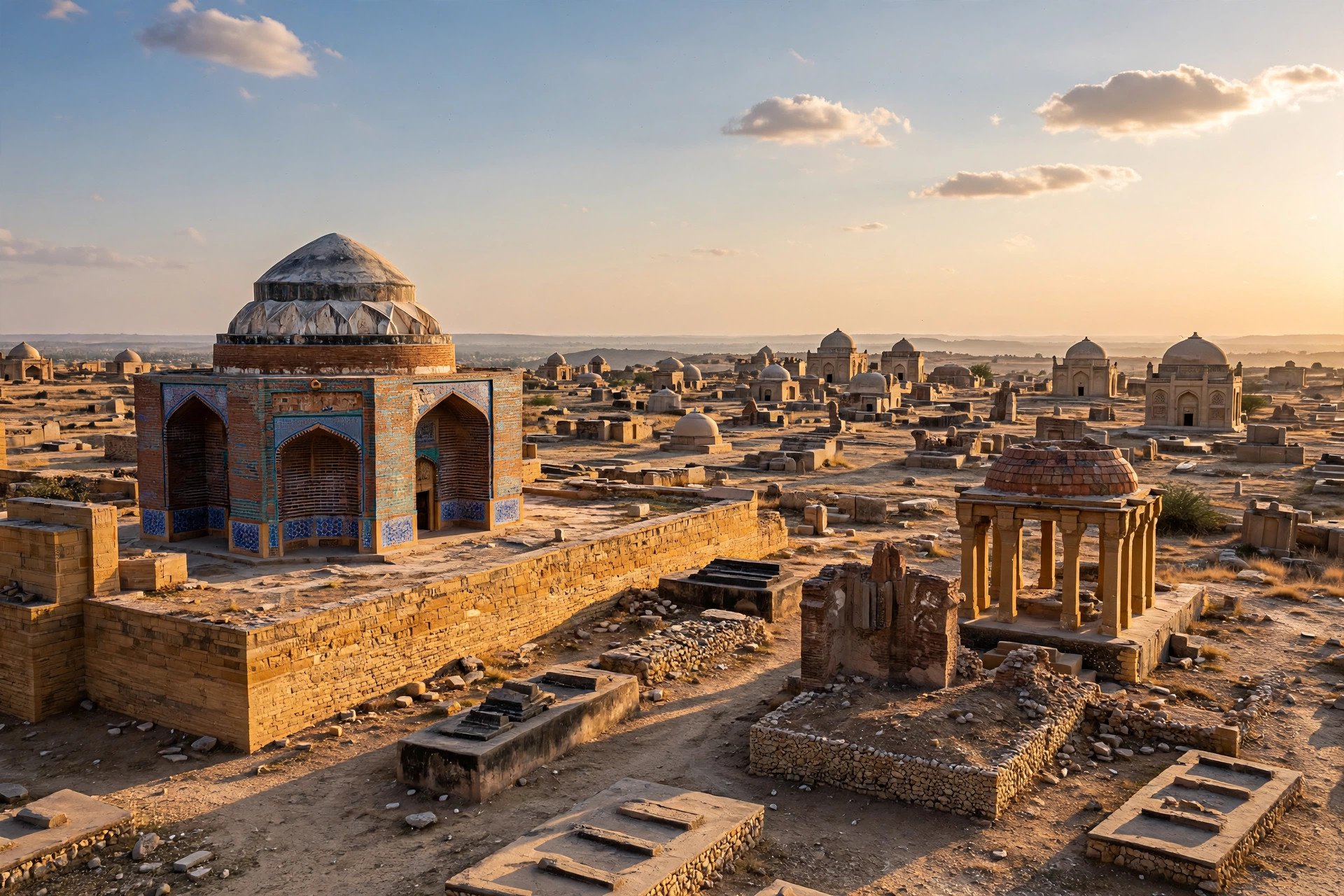
On a dry plateau near the old city of Thatta in Sindh lies a silent city built of stone — the Makli Necropolis, one of the largest graveyards in the world. Across about 10 square kilometres stand an estimated 500,000 to one million tombs, built over 400 years between the 14th and 18th centuries. Kings, queens, governors, Sufi saints, scholars and ordinary people rest here, and since 1981 the Makli Necropolis has been a UNESCO World Heritage Site.
Makli Necropolis History: How a Sufi Saint's Resting Place Became a City of the Dead
The story of the Makli Necropolis begins in the 14th century with the Sufi saint, poet and scholar Shaikh Jamali, who established a khanqah — a Sufi gathering place — at Makli and was eventually buried there. The Samma ruler Jam Tamachi venerated the saint and wished to be buried near him, and that wish began the tradition of using Makli as a funerary site. The site rose to prominence under the Samma dynasty, who ruled from 1351 and made their capital near Thatta, and it kept growing under the dynasties that followed — the Arghun, the Tarkhan and the Mughals — until the 18th century.
Tombs of Kings, Saints and Scholars at Makli Necropolis
The most architecturally significant tombs at Makli date from the Mughal era, roughly between 1570 and 1640. Among the outstanding stone monuments are the tombs of Jam Nizamuddin II, who reigned from 1461 to 1509, and of Isa Khan Tarkhan the Younger and his father Jan Baba, both built before 1644. The most colourful is the tomb of Diwan Shurfa Khan, who died in 1638, its glazed tiles still catching the light. The buildings combine traditions from western India, Persia and Central Asia, with Islamic, Hindu, Persian, Mughal and Gujarati influences woven into a distinct local style known as Chaukhandi. Some tombs are grand domed mausoleums; others are simple carved slabs — but together they form an open-air museum of Sindh's art, faith and power.
Makli Necropolis: A UNESCO World Heritage Site Under Threat
In 1981, the Historical Monuments at Makli, Thatta were inscribed as a UNESCO World Heritage Site, recognised as an outstanding testament to the medieval civilization of Sindh between the 14th and 18th centuries. But the site is fragile. Its sandstone and brickwork suffer from erosion, saline winds, monsoon rain, encroachment and poor management, and the floods of 2010 and 2022 added to the damage. Conservation work continues: after the 2022 floods, new initiatives were launched to protect the monuments, and in May 2025 UNESCO held a three-day workshop for Sindh's Directorate of Antiquities, teaching restoration techniques and best practices to the people who care for the site.
Visiting Makli Necropolis: A Journey Into Sindh's Past
Makli sits on a slightly elevated plateau about 6 kilometres from Thatta, and around 98 kilometres east of Karachi — an easy day trip from the city. Visitors walk among the domes and carved tombs as the sun sets over the plateau, reading centuries of Sindhi history in stone. It is a quiet, contemplative place, and it asks for quiet respect: this is not only a monument, it is a burial ground where half a million people rest. For anyone who loves Pakistan's history, Makli Necropolis is one of the most moving places in the country — a whole city of the dead, still speaking after 400 years.
Sources: UNESCO World Heritage Centre, Wikipedia, Nature Adventure Club, Saiyah
Source: UNESCO World Heritage Centre, Wikipedia, Nature Adventure Club, Saiyah
Comments
No comments yet. Be the first to share your view.