
Qissa Khwani Bazaar: Peshawar's Street of Storytellers, Qehwa and Chapli Kebab
By DunyaDesk · 2026-11-13
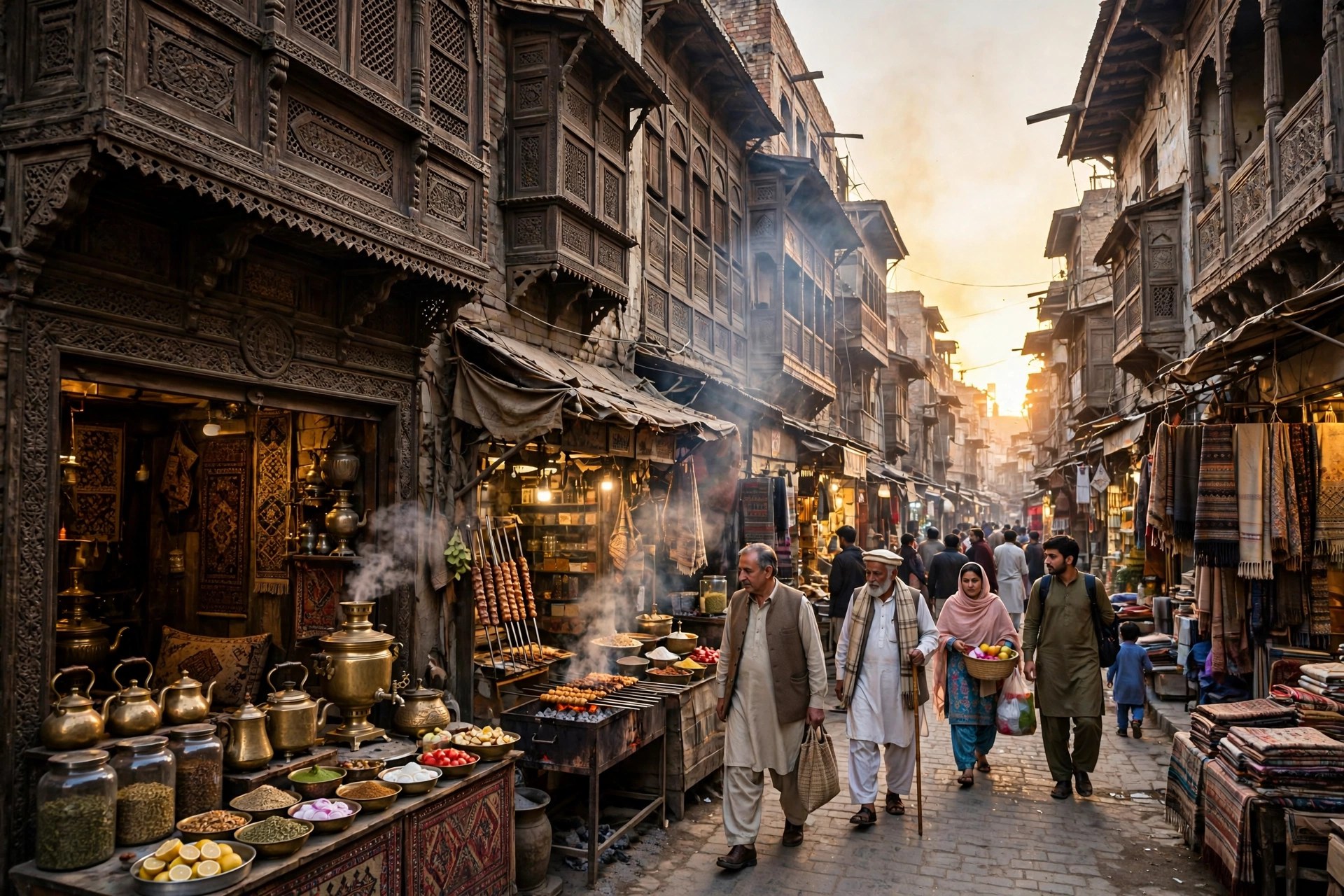
In the heart of Peshawar's old city, down lanes that smell of cardamom tea and sizzling meat, lies a market whose very name is a story. Qissa Khwani Bazaar — the "Storytellers' Market" — is one of the oldest and best-known bazaars in the walled old city of Peshawar, and it still does what it has done for centuries: it gathers people, pours them tea, and lets them talk.
Qissa Khwani Bazaar: Where Caravans Stopped to Tell Stories
Peshawar sat at the foot of the Khyber Pass, and for centuries traders and travellers coming down from Afghanistan and Central Asia stopped in its bazaars. Qissa Khwani became the place where they swapped news and stories over tea — merchants from Delhi, Amritsar, Lahore, Kabul, Dushanbe, Ashgabat and Tashkent unloaded their goods, then sat in candlelit gatherings to exchange tales of love, architecture, music and distant lands before crossing the legendary Khyber Pass.
The professional storytellers who entertained those caravan traders gave the bazaar its name, and British visitors later nicknamed it "the Piccadilly of Central Asia". The bazaar starts from Kabuli Gate, near Chowk Yadgar, Ghanta Ghar and the Bala Hisar Fort, and a walk through it still feels like stepping into another century — centuries-old buildings, artisans' shops, and tea houses where the conversation never really stops.
Peshawar's own history runs even deeper than the bazaar. Excavations at Gor Khatri, one of the deepest urban digs in the world, have traced the city's habitation back to around 539 BC, earning Peshawar the title of South Asia's oldest living city, according to the provincial Archaeology Department.
Qehwa and Chapli Kebab: The Taste of Qissa Khwani
No visit to the bazaar is complete without its two signatures. Peshawari qehwa — green tea, often flavoured with cardamom — is the bazaar's signature drink, poured in the qehwa khanas where travellers have gathered for generations. Beside it, the food stalls serve what Peshawar is famous for: chapli kebab, the spiced minced-meat patty fried fresh across the old city, along with paye, mutton karahi, fried fish and Kabuli pulao.
During Ramadan, the bazaar transforms. From Iftar to Sehri, the aroma of sizzling chapli kebab mingles with the fragrance of qehwa, and families gather at tables crowded with plates — a living museum of culture, memory and taste, as UrduPoint described it earlier this year. After Pakistan's creation, these same tea stalls became informal forums where locals debated everything from the Fatima Jinnah–Ayub Khan presidential contest to the 1965 war and Pakistan's 1992 Cricket World Cup triumph.
The Morning That Changed the Bazaar
The bazaar's history is not only one of commerce and hospitality. On 23 April 1930, British Indian Army troops opened fire on unarmed protesters of the non-violent Khudai Khidmatgar movement here. The authorities admitted 179 deaths; other estimates are far higher. The Qissa Khwani massacre became a turning point in the independence movement, and a white marble memorial in the area recalls it to this day.
In 2018, the Khyber Pakhtunkhwa government completed a Cultural Heritage Trail from Ghanta Ghar to Gor Khatri, restoring 85 historic buildings including the famed Sethi House — a reminder that the bazaar is not a relic, but a living part of the city. The storytellers are mostly gone, but the stories are still told here every evening, over the same qehwa, in the same lanes, by the same kind of people who have always gathered in Qissa Khwani.
Sources: Geo News; UrduPoint, 24 Feb 2026; The Nation, 31 Aug 2026; Around the World 4U travel guide; Evendo travel guide 2026.
Source: Geo News
Comments
No comments yet. Be the first to share your view.