
Ranikot Fort: The Great Wall of Sindh, the World's Largest Fort
By DunyaDesk · 2026-11-11
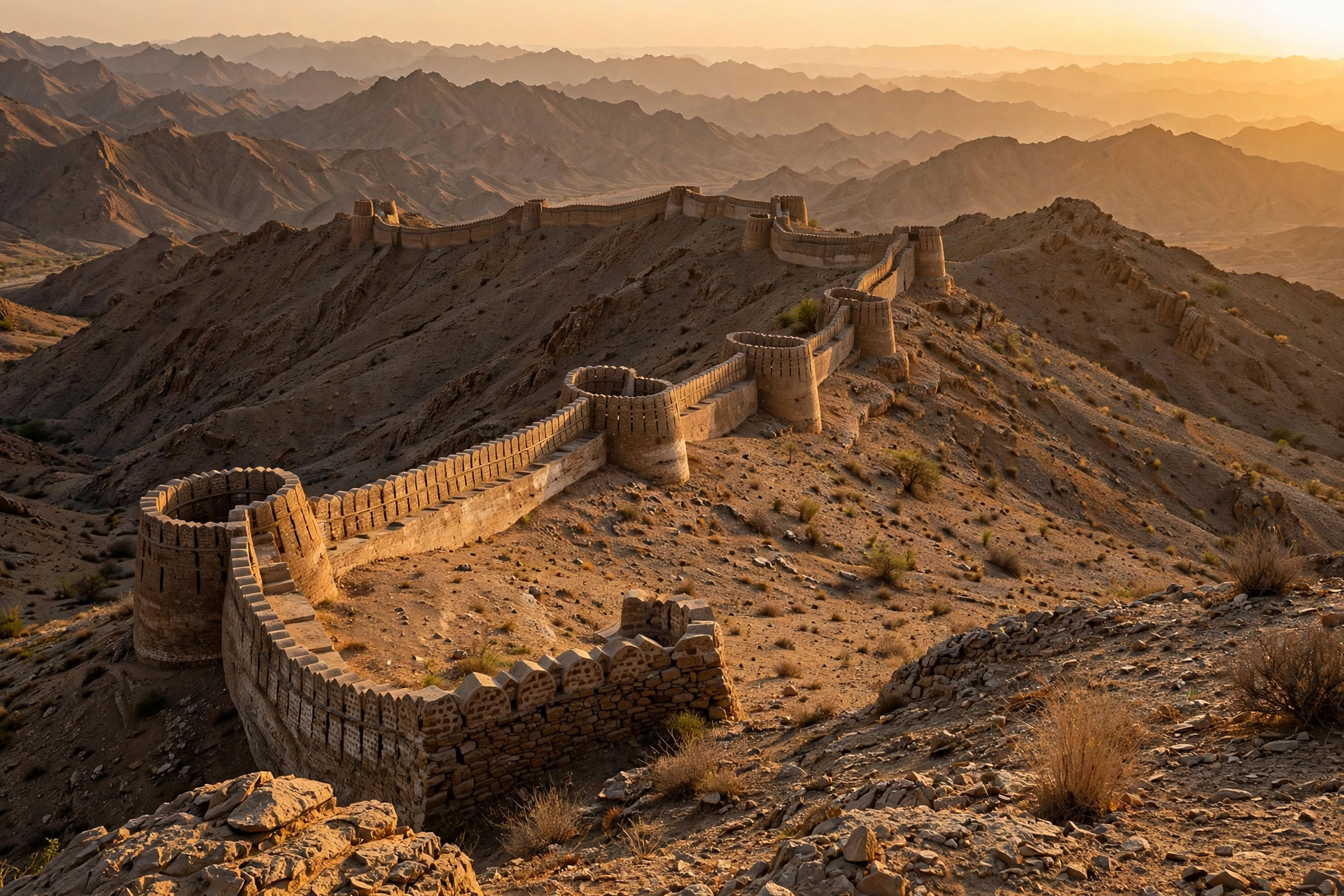
Ranikot Fort, known as the Great Wall of Sindh, is believed to be the world's largest fort. Its walls run for around 32 kilometres through the dry, rocky Kirthar hills near the town of Sann in Jamshoro district, Sindh — a wall so long that it has been compared, again and again, to the Great Wall of China.
Ranikot Fort: A Wall That Runs for Miles
Ranikot Fort is not a fort in the usual sense. It is a long, roughly rectangular wall that follows the ridges of the Kirthar hills, enclosing three smaller forts within its perimeter — Mohan Kot, Meri Kot and Sher Garh. Most travel and heritage sources put the wall at around 32 kilometres long, though estimates vary. The walls are built of limestone and sandstone, and in places they stand about six metres high, rising higher at the round bastions that guard the gates. Standing on the wall at sunset, with ridge after ridge fading into the haze, it is easy to see why visitors call it the Great Wall of Sindh.
Who Built Ranikot Fort? A Mystery Without an Answer
Nobody knows for certain who built Ranikot Fort, and that mystery is part of its pull. Some historians have suggested very old origins, even centuries before Christ. What most historians and archaeologists do agree on is that the present structure was built or thoroughly renovated by Mir Karam Ali Khan Talpur in 1812, when the Talpur Mirs ruled Sindh. A radiocarbon study in 2009, on charcoal from a crumbled pillar near the Sann Gate, found that at least that part of the fort was renovated in the early 18th and 19th centuries — the times of the Kalhora and Talpur dynasties. The original builder, though, remains unknown, and that is why Ranikot is often called one of Pakistan's greatest historical mysteries.
A World Heritage Hope Since 1993
Ranikot Fort was nominated by the Pakistan National Commission for UNESCO World Heritage status in 1993, and it has remained on UNESCO's tentative list ever since. It is also listed as a historical site under the Antiquities Act of 1975, which gives it legal protection. Yet, as Dawn noted in a 2013 heritage piece, the fort is among the worst-neglected archaeological sites in Sindh — the only thing the archaeology department had installed there was a signpost with a blurred map. The wall that was built for defence now needs defending itself.
How to Visit Ranikot Fort
Ranikot Fort lies about 90 kilometres north of Hyderabad on the Indus Highway (N55), near Sann town in Jamshoro district, inside Kirthar National Park — the second-largest national park in Pakistan. The best time to visit is in the winter months, from November to February, when daytime temperatures are pleasant and walking the ridges is comfortable. The Sann Gate is the usual entry point, and from the higher bastions the wall can be seen winding away over the hills in both directions. There are few facilities at the site itself, so visitors usually come with food, water and a local guide, and many combine the trip with the nearby shrines and villages of the Kirthar range.
Why Ranikot Fort Matters
Pakistan is home to the world's largest fort, and very few Pakistanis have seen it. Ranikot is a reminder that Sindh's history is not only Mohenjo-daro and the tombs of Makli — it is also this enormous, silent wall in the hills, built by hands whose names are lost, waiting on a world heritage list for more than thirty years. If it is ever properly protected and presented, it could be one of the country's great travel destinations. Until then, it waits — golden in the evening light, and almost empty.
Sources: Dawn, UNESCO tentative list, Nature Adventure Club, Pakistan Traveler, Paradigm Shift, Sindhi Podcast
Source: Dawn, UNESCO tentative list, Nature Adventure Club, Pakistan Traveler, Paradigm Shift, Sindhi Podcast
Comments
No comments yet. Be the first to share your view.