
Skardu Valley: Gateway to K2, Shangrila Lake and the Karakoram
By DunyaDesk · 2026-11-16
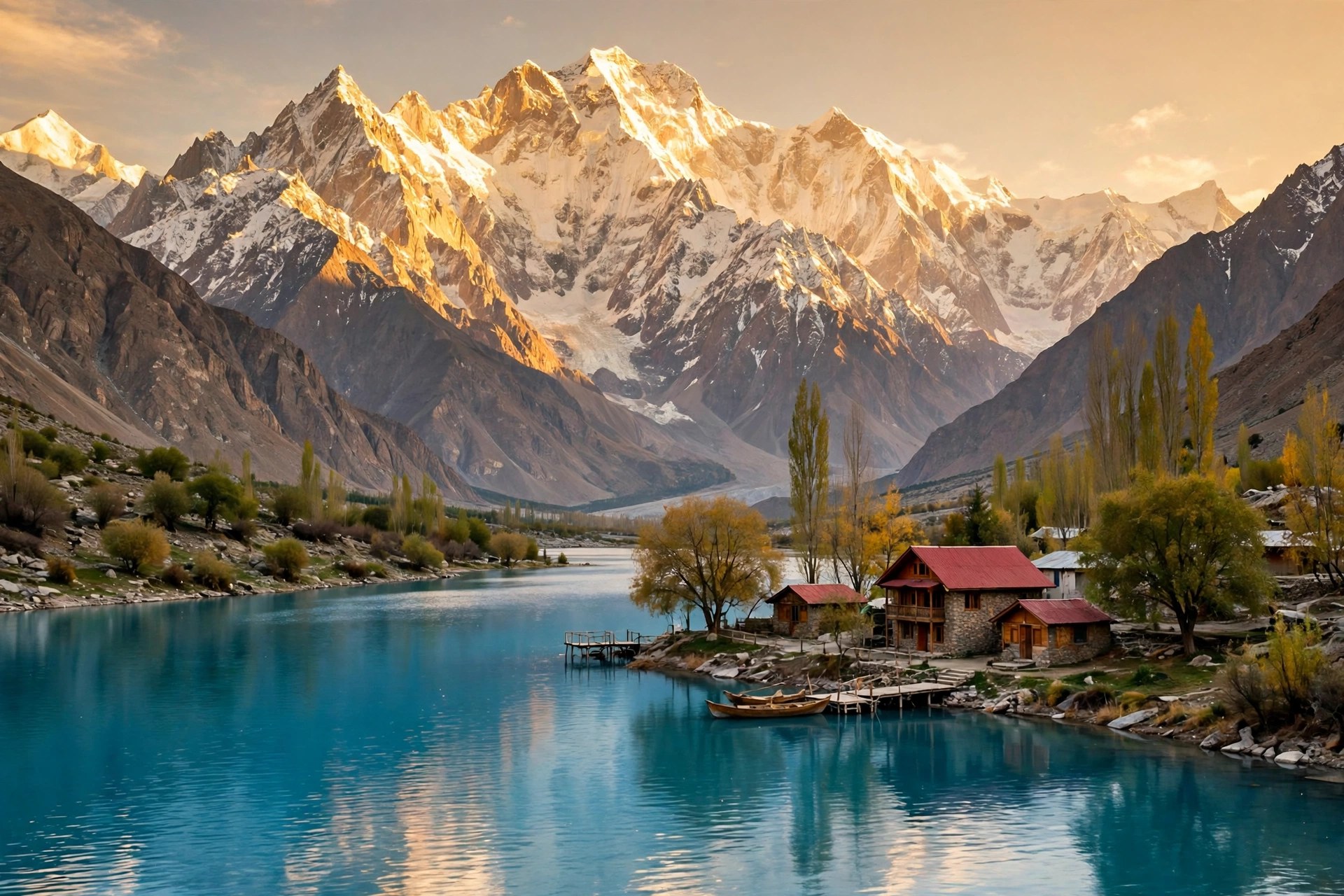
Skardu Valley lies in Gilgit-Baltistan, where the Indus River meets the Shigar River, in a wide sandy basin ringed by the peaks of the Karakoram. The valley floor sits at about 2,230 metres above sea level, and barren brown mountains enclose it on every side, with the giants of the Karakoram standing behind them. Skardu is the main town of Baltistan, and for mountaineers it is the last town before the long approach to K2, while for most other visitors it is a base for lakes, deserts, forts and the high Deosai plateau.
What makes Skardu special is that it is the gateway to the highest mountains on Earth. All expeditions to K2 Base Camp, Broad Peak and the Gasherbrum peaks begin here. K2, at 8,611 metres, is the world's second-highest mountain, and Skardu gives access to four 8,000-metre peaks — K2, Gasherbrum I and II, and Broad Peak. K2 itself cannot be seen from Skardu town; it lies deep in the Karakoram, days away on foot, and is visible only from the upper Baltoro Glacier. But Skardu is where every great Karakoram journey begins.
Skardu Valley: Lakes of Turquoise Water
The most famous sight near Skardu is Shangrila, also known as Lower Kachura Lake, about 32 kilometres from the town. The Shangrila Resort sits directly on the lake's edge, built in a traditional Chinese style with distinctive red pagoda roofs, and its gardens are one of the most photographed places in Gilgit-Baltistan. A short distance away lies Upper Kachura Lake, locally called Frogh Scho, a deep, clear lake among orchards and willows that is quieter than its famous neighbour.
Satpara Lake lies about 8 kilometres north of Skardu, surrounded by glacial mountains mirrored in its crystal-clear waters, and it is known for its brown trout. In spring, the valley's orchards of apricots, peaches, apples and pears burst into blossom, and in summer the fruit ripens on the trees — Baltistan's valleys are famous across Pakistan for their fruit.
Forts, Deserts and the Roof of the World
Skardu is not only about lakes. Shigar Valley, 23 kilometres away, is the gateway to the great peaks, with terraced fields of wheat, maize and barley and the historic Shigar Fort, now a hotel. Khaplu Valley, 103 kilometres to the east along the Shyok River, is the starting point for expeditions to Masherbrum and the Saltoro peaks. And above the valley lies Deosai National Park, one of the highest plateaus on Earth at an average elevation of about 4,100 metres, a vast rolling plain that travellers cross on the way to and from Skardu.
Then there is the Cold Desert, the Katpana desert near Skardu — a stretch of sand dunes at high altitude, one of the highest cold deserts in the world. Sand, snow peaks and a cold wind in one frame: it is the sight that surprises first-time visitors most.
A Place for Travellers and Dreamers
Skardu can be reached by air — its airport, at roughly 2,230 metres, receives scheduled flights from several Pakistani cities when the weather is clear — or by road from Islamabad along the Karakoram Highway, following the Indus gorge for much of the way. The main tourist season runs from April to October, when the days are warm and the mountain passes are open.
For the people of Baltistan, Skardu is home — a town of Balti culture, apricot orchards and old forts, where porters and guides have carried expeditions toward K2 for generations. For visitors, it is the place where the journey to the highest mountains begins, and where a turquoise lake at sunset is enough to make the whole long road worthwhile.
Source: Adventure GB, LuxPines, DailyLife.pk, Wikivoyage
Comments
No comments yet. Be the first to share your view.