
Pakistan Solar Revolution: Rooftop Panels Now Power 28%
By DunyaDesk · 2026-11-20
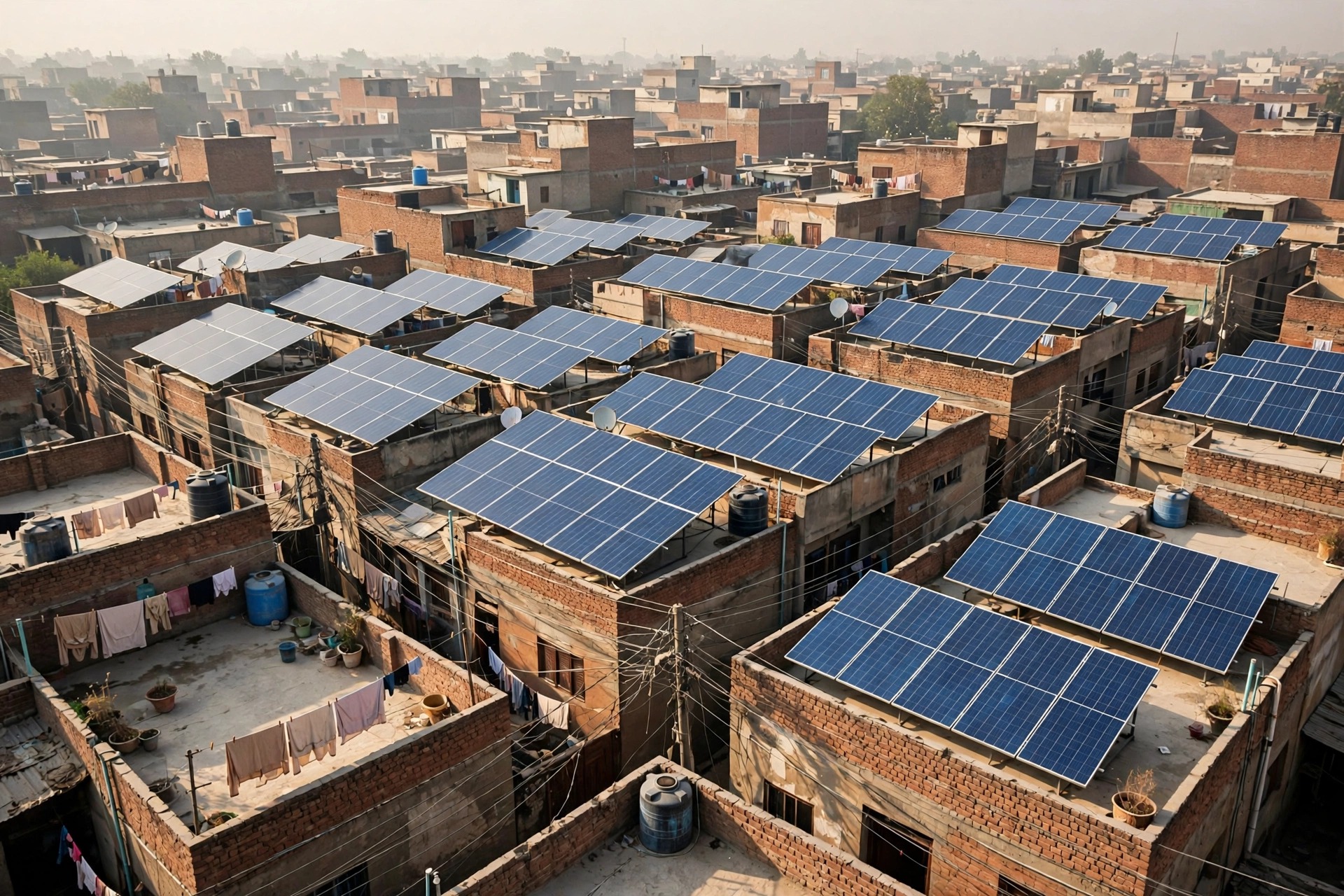
Three months after his wedding, Faisal Shahzad's home in rural Punjab is full of gifts from his bride's family — jewellery, glimmering silverware, sofas and an air-conditioning unit. But his most prized possession is tucked under the bed: a 340-watt solar panel. All last summer, he ran his air cooler on it from morning till evening without touching grid power at all. His story is the human face of the Pakistan solar revolution, which has taken solar power from just 1% of the country's electricity in 2018 to 28% in 2025, according to Pakistan-based think tank Renewables First. Around seven million households now own solar panels.
Pakistan has seen a boom in imported solar panels, which now glisten from the rooftops of homes and hospitals, from farmers' fields to industrial complexes. People used to gift motorbikes or other household items at weddings, Shahzad told the BBC. "Now they give a solar panel and an air cooler. It has almost become a must." With around 250 to 300 sunny days a year, Pakistan is made for rooftop solar — and families are grabbing the chance.
A Revolution Built on Rooftops, Not Government Plans
The big pivot to solar was not driven by government policy. It was driven by individual Pakistani households. Most people the BBC spoke to said they installed panels to escape soaring electricity prices from an often unreliable national grid. Electricity tariffs have more than doubled in a few years, says Muhammad Hassan Dajana, industry liaison at Renewables First, while the cost of Chinese solar panels has fallen by 93%. In a country where the average wage is just under 40,000 Pakistani rupees a month, electricity bills rising to 15,000–18,000 rupees have become unaffordable for many families.
The scale is remarkable. According to analysis by energy think tank Ember and Renewables First, Pakistan added 27 gigawatts of distributed solar capacity in just two years, reaching about 38 gigawatts by June 2025. In 2024 alone, Pakistan imported around 17 gigawatts of solar panels — more than double the previous year — making it one of the largest buyers of Chinese panels in the world. Solar generation more than tripled, from 15 terawatt-hours in the 2023 financial year to 51 terawatt-hours in 2025. A household solar-and-battery system now delivers electricity at around 20 rupees per unit, compared with roughly 40 rupees for grid power and 120 rupees for a diesel generator.
The boom is not limited to homes. At Kohinoor Textile Mills in Islamabad, a sea of huge blue solar panels powers the factory. When the sun shines, the mills' hundreds of machines run entirely on solar energy, and the heavy-furnace-oil engines they once relied on sit mothballed in a warehouse. "We needed to reduce our energy costs and this was one way to do it," says chief executive Taufique Sayeed Saigol. The company will soon start using industrial batteries to store excess solar energy — though at night, and on cloudy days, it still takes power from the national grid.
The Grid Is Falling Behind
While Pakistan has become a poster child for solarisation, the national grid is experiencing knock-on effects. When people buy less energy from the grid, fewer customers are left to cover the fixed costs of maintaining it. That can force prices up — which in turn encourages even more people to switch to solar. Pakistan needs to avoid this so-called utility death spiral, which over time can leave those who cannot afford panels facing ever-rising bills, while the national grid becomes an increasing burden on the state. "You'll have a white elephant in the form of a state-owned enterprise that requires a lot of public funding to just stay afloat," Dajana warns.
Pakistan's government says the costs are already being felt. "In just the past two years, the exodus from the grid has cost the rest of the consumers more than $500 million a year," Energy Minister Awais Ahmad Leghari told the BBC at COP31. "That's a very big burden." The government also changed its net metering rules earlier this year: households used to feed excess electricity into the grid and earn credits, but now the power they export is bought at a lower rate. Leghari says the old model did not add up — had it continued, the rest of the consumers would have been burdened by at least 150 to 200 billion rupees a year within two years.
Leghari insists the government does not want to pull people away from solar. It wants the grid to be more competitive, with better storage, less waste and more innovation, and says most of the costly private power producer contracts have been renegotiated. His ambition is for Pakistan to run on up to 90% clean power by the end of 2036 — including renewables and nuclear — cutting dependence on imported energy from 26% to 4%. There are also plans to open solar battery factories around the country and encourage more electric vehicles. The rapid shift is estimated to have saved $12 billion in LNG imports between 2022 and 2026.
For now, the revolution is not slowing down. Shahzad plans to buy another 10 to 15 panels, install them on the roof and connect a full system with batteries. "The plan is to be fully self-sufficient," he says. As Dajana puts it, there are two paths ahead: one where solar and the grid work in parallel, showing how a gradual energy transition can succeed — and another where Pakistan becomes a cautionary tale, burdened with a costly, declining grid. Which path the country takes will decide whether the solar boom stays a success story for every Pakistani, or only for those who can afford a panel.
Sources: BBC, Gulf News, The Business Standard, Ember / Renewables First, The Fact Wire
Source: BBC, Gulf News, The Business Standard, Ember / Renewables First, The Fact Wire
Comments
No comments yet. Be the first to share your view.