
Passu Cones: Pakistan's Cathedral Peaks in Hunza
By DunyaDesk · 2026-11-24
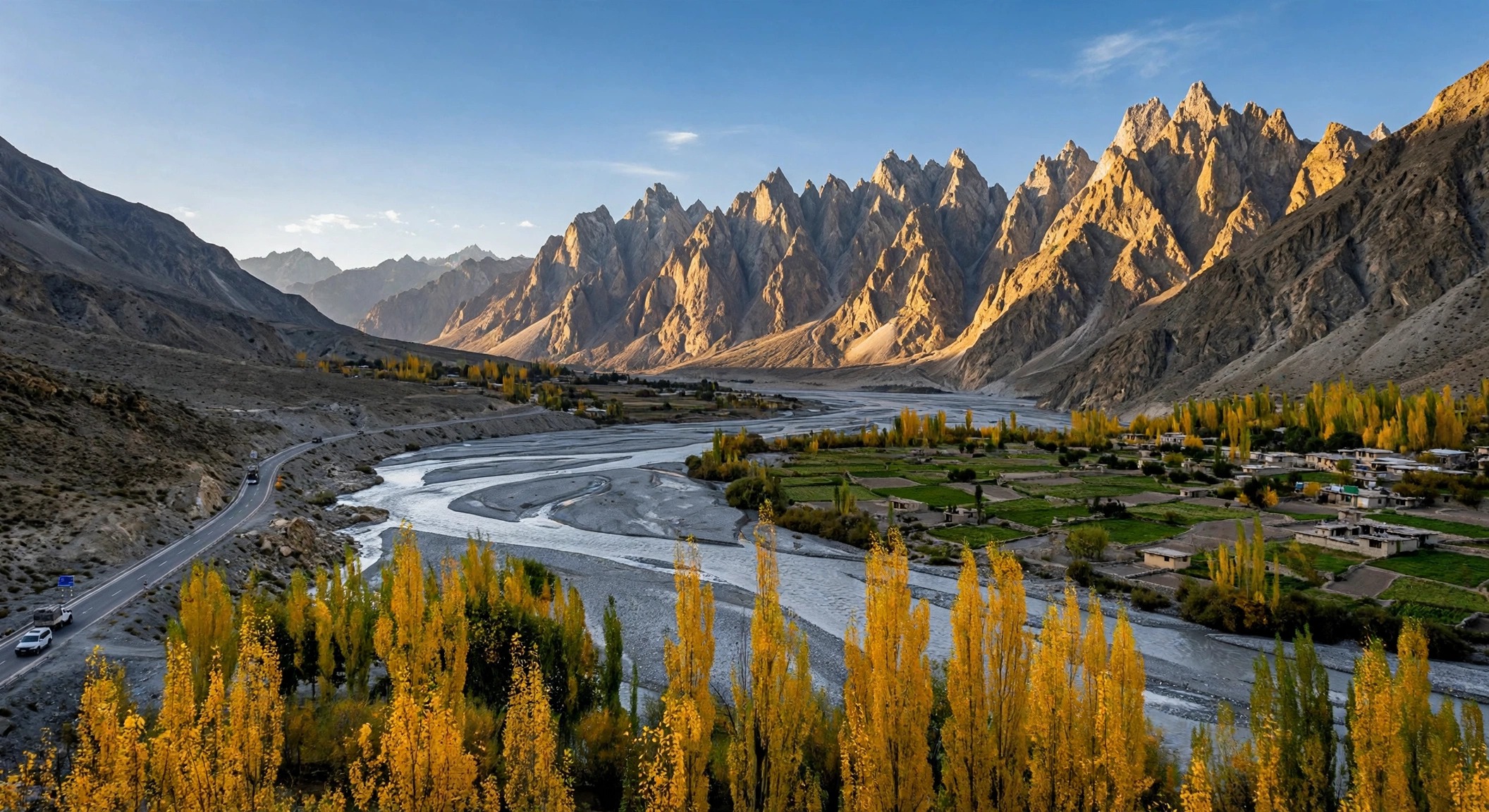
The Passu Cones are the row of sharp, dark spires that rise above the village of Passu in upper Hunza — one of the most photographed mountain views in Pakistan, and a sight every traveller on the Karakoram Highway stops for.
Known locally as Tupopdan, which means "sun-swallowing mountain" in Wakhi, the massif stands about 6,106 metres (20,033 feet) above sea level. Travellers also call it the Passu Cathedral, because the pointed peaks look like the spires of a great gothic church. At sunset the rock glows red-gold, and the name suddenly makes sense.
Where the Passu Cones stand
The Passu Cones stand in Gojal, the upper part of the Hunza valley in Gilgit-Baltistan, directly above Passu village on the Karakoram Highway. Passu is about 20 kilometres north of Gulmit, roughly 45 minutes beyond Attabad Lake and around an hour and a half from Karimabad, the main town of central Hunza.
The cones need no trek to see. The classic view is from the Karakoram Highway itself, where a roadside viewpoint a few kilometres south of Passu gives the straight-on "cathedral" angle. From the village lanes, the spires rise behind apricot orchards and golden poplar trees. The Hussaini suspension bridge — a swaying span of planks and cables over the Hunza River — frames the peaks beautifully and has become a destination in its own right, though it is not for anyone uneasy with heights.
Behind the cones stands Passu Sar, a separate and much higher peak at 7,478 metres. The two are often confused, but the cones are Tupopdan, not Passu Sar.
Best time to visit the Passu Cones
The best time to visit the Passu Cones is from May to October, when the roads are open and the guesthouses are running. April and May bring blossom in the villages with snow still on the peaks; June to September is warm and green, the busiest season; and mid-October to early November is the photographers' favourite, when the poplars below the cones turn bright gold under clear skies.
Winter is a different world: very cold, with few services open and the Hussaini Bridge sometimes icy. The cones look dramatic under snow, but winter travel here is for experienced travellers only. Whatever the season, the best light is early morning and late afternoon, when the low sun sets the spires glowing.
More than a viewpoint
The Passu Cones are a serious mountaineering objective, not a trekking peak — steep, loose and rarely climbed, with only a handful of ascents. For everyone else, the pleasure is in looking: walks around Passu village, the glacier viewpoints, Borith Lake's reflections, and the slow drive onward toward the Khunjerab Pass.
That is the real charm of Passu. The cones are not hidden at the end of a long trail. They stand beside the road, above a quiet Wakhi village, and they stop traffic — drivers, photographers and families alike — every single day.
Sources: Go With Guide, Hunza and Beyond, Pakistan Travellers, GoVisitPak, Explore Pakistan Tours, The Golden Adventure, DailyLife.pk.
Comments
No comments yet. Be the first to share your view.