
Shalimar Gardens Lahore: Shah Jahan's Mughal Paradise
By DunyaDesk · 2026-11-15
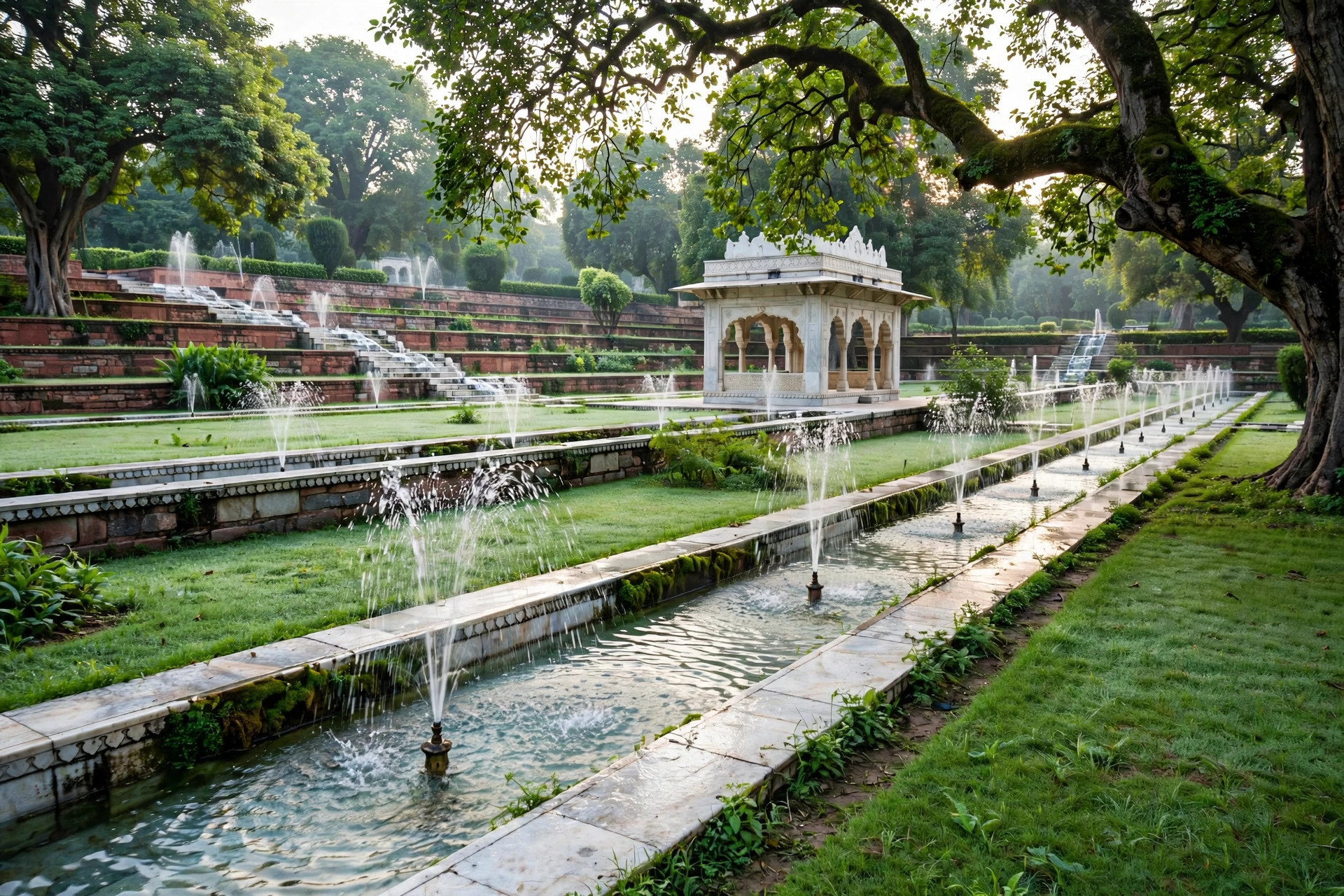
Shalimar Gardens Lahore is one of the finest Mughal gardens in the world — a terraced paradise of water, marble and green lawns built by Emperor Shah Jahan in 1641, and a UNESCO World Heritage Site since 1981.
The gardens stand at Baghbanpura, about five kilometres northeast of Lahore's main city, near the Grand Trunk Road. Shah Jahan commissioned them in 1641, and construction was finished within about a year. The work on site was overseen by Khalilullah Khan, a noble of Shah Jahan's court, with Mulla Alaul Maulk Tuni, while Ali Mardan Khan oversaw the canal that brought water to feed the fountains. The design was modelled on the Shalimar Garden that Shah Jahan's father, Jahangir, had built in Kashmir about two decades earlier.
Shalimar Gardens Lahore: Three Terraces, Three Meanings
The whole complex is a long walled rectangle, about 658 metres from north to south and 258 metres from east to west, covering nearly 16 hectares. Rather than one flat garden, it is cut into three descending terraces, each roughly four to five metres below the one before it.
The upper terrace is Farah Baksh, the "Bestower of Pleasure", once reserved for the royal family. The middle terrace is Faiz Baksh, the "Bestower of Goodness", where the emperor received noble guests and held court. The lowest terrace is Hayat Baksh, the "Bestower of Life", which was open to the public. Each level is a step down in height and a step outwards in who was allowed to enjoy it — a hierarchy built into the landscape itself.
The layout follows the Persian charbagh, the classical four-part garden that mirrors the four rivers of paradise. Shalimar's genius is that it takes that flat, symmetrical idea and sets it on a slope, so water can flow downhill from one terrace to the next.
410 Fountains That Run Without Pumps
Water is the soul of Shalimar Gardens. From a raised reservoir and a canal, 410 fountains rise and discharge into wide marble pools — 105 on the upper terrace, 152 in the middle and 153 on the lower one. Five cascades, including the well-known Sawan Bhadoon, carry the water down between the levels.
None of it runs on pumps. The entire system is gravity-fed: water drops through a network of channels and sluices, timed and pressured only by the elevation drop between the terraces. The water originally came through the Shah Nahar canal from the Ravi River — Mughal engineering that still works nearly four centuries later.
From Mughal Glory to UNESCO Protection
The gardens have not had an easy history. The first major rupture came in 1761, when Ahmad Shah Durrani invaded Lahore. The gardens then passed through Sikh and British rule, suffering damage and neglect, before being nationalised in 1962.
Recognition came in 1981, when UNESCO inscribed the Lahore Fort and Shalimar Gardens together as a World Heritage Site. The honour came with a warning: because of neglect, urban encroachment and damage to the historic fabric, the site was placed on the List of World Heritage in Danger at the same time. It stayed there until 2012, when UNESCO removed it after significant progress in conservation. Today the gardens are managed by the Walled City of Lahore Authority.
Nearly four hundred years after Shah Jahan's gardeners planted it, Shalimar remains what it was built to be — a quiet, green escape from the city around it, where the sound of running water has never stopped.
UNESCO World Heritage Centre; Wikipedia; TrulyPakistan; Around the World 4U; Audiala; Dev.to heritage overview.
Comments
No comments yet. Be the first to share your view.