
Taxila Pakistan: The Ancient Gandhara City of Stupas and Monasteries
By DunyaDesk · 2026-11-14
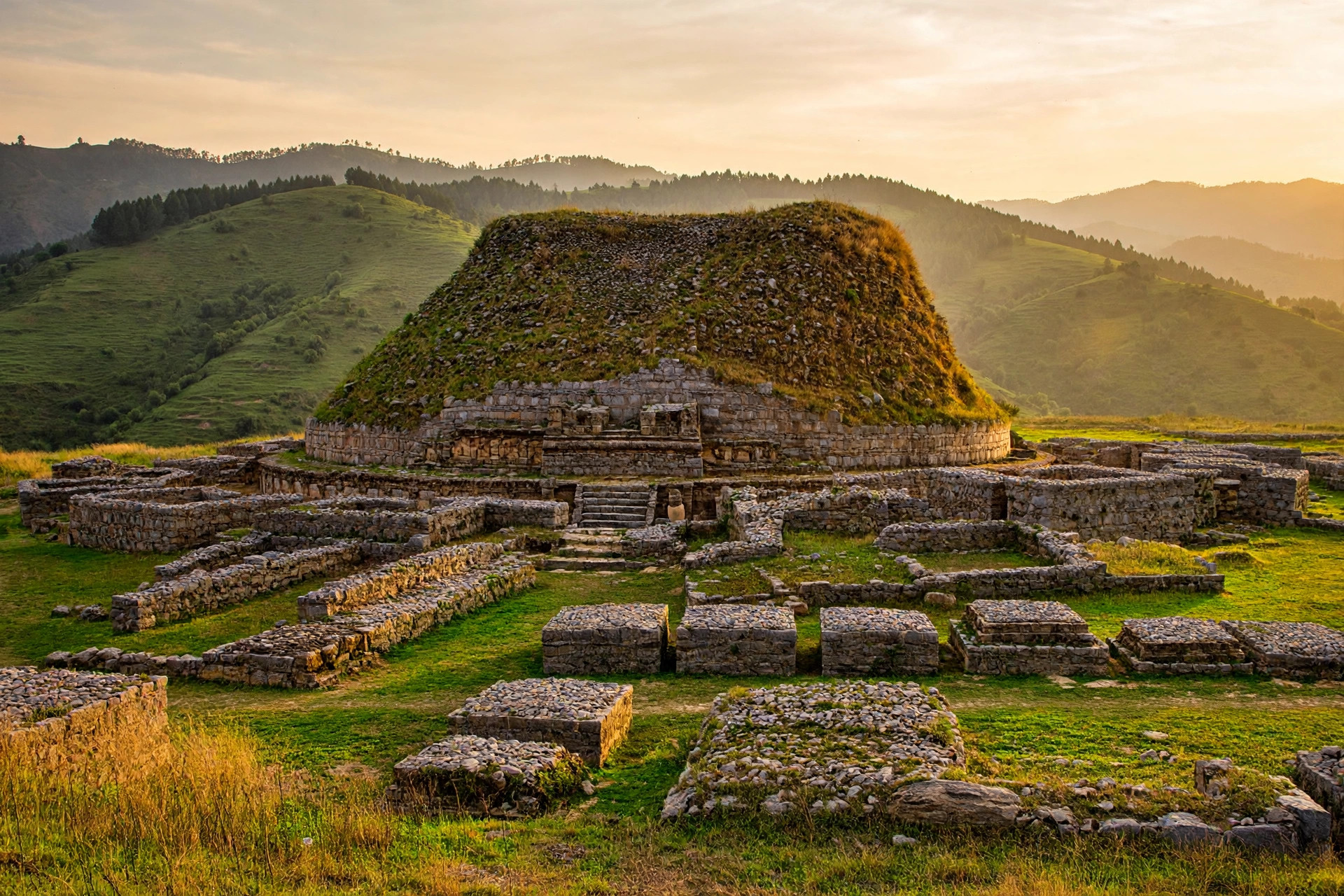
Taxila Pakistan is one of the most important archaeological sites in South Asia — a UNESCO World Heritage city where Persian, Greek, Mauryan and Kushan rulers left their mark, and where Buddhist monks studied for five centuries. It lies about 35 km northwest of Islamabad and Rawalpindi, an easy hour's drive from the capital, yet it feels like another world.
Known in Sanskrit as Takshashila, Taxila was a crossroads of civilisations for more than a thousand years — a centre of Buddhism, a hub of learning, a bustling metropolis and a meeting point of cultures from Persia to Greece to Central Asia.
Taxila Pakistan: A City Older Than Empires
The story of Taxila begins long before the famous ruins. Evidence from Sarai Kala goes back to the Neolithic, Bronze and Iron Ages, while the Bhir Mound is considered the oldest historic city of Taxila, likely established in the 6th century BCE under Achaemenian influence.
Persia governed here, Alexander was hosted here in 326 BC, and the Mauryan emperor Ashoka built here. Then came five centuries of Buddhist scholarship that made the name famous from China to the Mediterranean. The city passed through the hands of Indo-Greeks, Scythians, Parthians and Kushans — each leaving a layer in the ground that archaeologists are still reading today.
Taxila sits at the head of the Doaba, the land between the Indus and the Jhelum rivers, on the old trade routes that once linked Central Asia with the subcontinent. That position — between rivers, between empires — is why so many rulers wanted it.
Dharmarajika Stupa: The Great Stupa of Taxila
The Dharmarajika Stupa is the largest stupa at Taxila, and its most sacred monument. By tradition it was built by the Mauryan emperor Ashoka in the 3rd century BCE over relics of the Buddha, though some archaeologists question that link. The current stupa was re-established in the 2nd century CE, during the Kushan era, to house relics of the Buddha.
A ring of smaller votive stupas and a sprawling monastery grew around it over the following centuries. The British archaeologist Sir John Marshall excavated the site in 1913, and among the monastery cells his team found the remains of monks killed in the Hun sack of the 5th century — the attack by the White Huns that devastated the site and left it abandoned.
The stupa's scale still impresses: its central dome measures about 131 feet across and rises some 45 feet high, according to Beautiful Places Pakistan. It stands about a kilometre outside the old city of Sirkap, in line with the ancient Gandharan belief that monasteries should stand neither too close to nor too far from a town.
Sirkap, Jaulian and the Gandhara Art of Taxila
Beyond the great stupa, Taxila is a whole landscape of ruins. Sirkap was a planned city of the Indo-Greeks, its streets laid out on a grid. Jaulian, a monastery on a hilltop, and Mohra Muradu preserve the quiet courtyards where monks lived and studied.
It is the art that made Taxila famous. Between roughly the 1st and 5th centuries AD, Gandharan sculptors fused Greek technique with Buddhist subject matter and produced some of the first human images of the Buddha — wavy-haired and toga-draped, like an Apollo in meditation. That fusion, Greek form with Buddhist meaning, is what the word "Gandhara" still means to art historians around the world.
The Taxila Museum, purpose-built in 1928, holds thousands of pieces from Marshall's excavations: schist panels telling the life of the Buddha, serene stucco bodhisattvas, and coins and jewellery that trace the city's long trade with the ancient world.
Taxila UNESCO World Heritage Site: Visiting Today
Taxila was inscribed by UNESCO in 1980 as a serial site: a Mesolithic cave, four settlement mounds and eighteen monuments spanning more than a thousand years of urban life, listed under criteria iii and iv.
Today it is among the most important archaeological zones in South Asia, spread across several separate ruin complexes and a museum within a few kilometres of the modern town. The sites are close enough to cover in a full day from Islamabad — the museum first, for the story, then the stupa and the monasteries, where the stones tell it better than any label can.
Taxila rewards slow looking. Stand at the Dharmarajika Stupa at sunset and you are standing where monks stood fifteen hundred years ago, in a city that taught the ancient world — and then quietly waited, under the earth, to be found again.
Sources: Wikipedia (Dharmarajika Stupa); Go With Guide, Taxila heritage tour (updated Nov 2026); Tourism Guidebook, Taxila guide (updated May 2026); Beautiful Places Pakistan; Lakeshore City.
Comments
No comments yet. Be the first to share your view.