
Trump Xi Putin Peace Declaration After Shenzhen Summit
By DunyaDesk · 2026-11-19
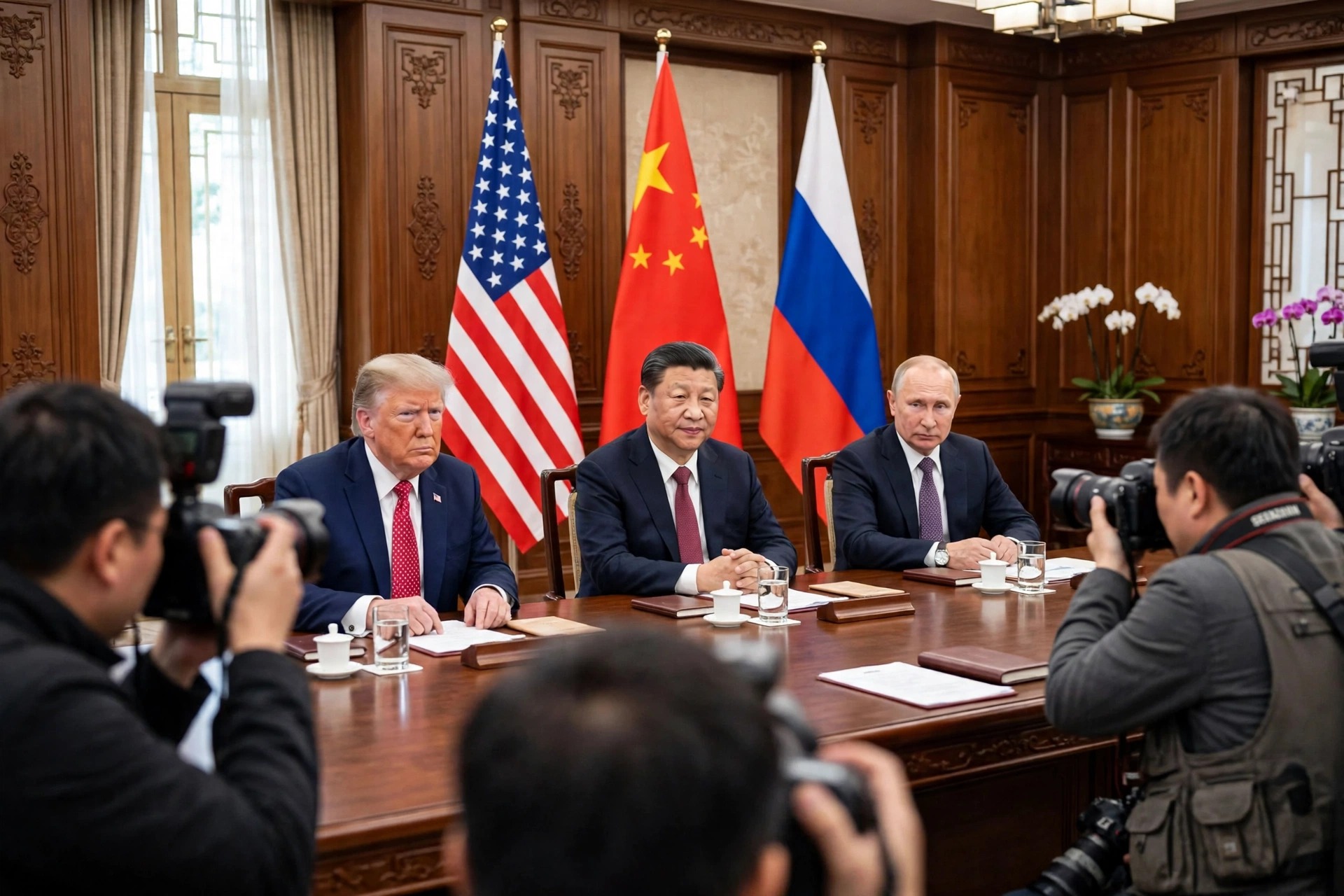
Donald Trump, Xi Jinping and Vladimir Putin have signed a joint peace declaration after their first-ever trilateral summit in Shenzhen, agreeing to hold talks on reducing nuclear risks and reaffirming that a nuclear war "cannot be won and must never be fought". The Trump Xi Putin peace declaration caps around 90 minutes of talks at Kylin Villa, a secluded government guesthouse in the hills above the southern Chinese city, held on the sidelines of the Asia-Pacific Economic Cooperation (APEC) summit.
The declaration, titled "The Russia-China-US Heads of State Declaration Toward Peace", was adopted on Thursday 19 November after the three leaders — the heads of the world's three biggest nuclear powers — sat down together for the first time. It is the formal outcome of a meeting that Trump had promoted as a chance to set new rules for controlling nuclear weapons.
Trump Xi Putin Peace Declaration: What It Says
The joint declaration commits the three countries to four broad areas. First, as permanent members of the United Nations Security Council, they pledged to reform the United Nations so it can respond more effectively to global challenges and fulfil its mission of maintaining international peace and security. Second, they agreed to increase the production and supply of refined petroleum products for the benefit of all nations, reaffirming the importance of stable energy flows.
Third, the declaration upholds the immunity enjoyed by state officials in international courts — a reference that comes more than three years after the International Criminal Court in The Hague issued arrest warrants for Putin and other Russian officials over alleged war crimes during Russia's invasion of Ukraine. Fourth, the three leaders reaffirmed that a nuclear war cannot be won and must never be fought, and said their countries would conduct a dialogue on reducing nuclear risks and preventing the proliferation of nuclear weapons.
No mention of Ukraine or Iran
The declaration made no mention of Russia's war in Ukraine or the conflict with Iran, even though Trump said he had raised both during the discussions. It contained no commitments to reduce nuclear arsenals and set no timetable for the promised dialogue on nuclear risks, and it spelled out no specific timelines or mechanisms for implementing any of its commitments.
Putin conceded after the summit that the declaration did not set ambitious goals and added that nobody would be forced to comply with its decisions. The outcome matched the low expectations that experts and a senior US official had set before the meeting — "We do not expect to get to any kind of agreement," the official had said.
Nuclear war cannot be won
The nuclear language is the declaration's centrepiece, and it comes at a sensitive moment: the New START treaty, the last agreement limiting the strategic nuclear arsenals of Washington and Moscow, expired earlier this year. China has long resisted US efforts to draw it into formal nuclear discussions, arguing that its arsenal is far smaller than those of the other two powers.
The Arms Control Association's executive director, Daryl Kimball, noted that the declaration contained no commitments to reduce arsenals — only a promise of dialogue, without a time frame. Smaller countries watched the summit uneasily, concerned that their interests could be disregarded by the three major powers, and some commentators compared the gathering to the 1945 Yalta conference — a comparison about symbolism, not substance, since no Yalta-style agreement was negotiated.
Putin hails a new chapter
Putin hailed what he called a "new chapter in the history of diplomacy" after the talks, and the three leaders described their meeting as historic. Trump left Shenzhen for Washington after the summit, as the three sides decide whether the dialogue continues.
The trilateral followed two separate bilaterals earlier in the day. Trump and Putin spoke for around 40 minutes, with Ukraine the main topic, while Trump and Xi held an hour-long meeting on trade, technology and farm purchases before the three leaders sat down together, with Xi chairing the trilateral session. Trump is also due to phone Japanese Prime Minister Sanae Takaichi after the summit.
The declaration gives the historic gathering a formal outcome, but its test will be what follows: whether the promised dialogue on nuclear risks ever produces a timetable, and whether the three powers — who could not agree on the wars in Ukraine and Iran — can agree on anything concrete next.
Sources: Korea Times, The Wall Street Journal, The Times of India, The New Indian Express, The Economic Times, Al Jazeera, WION, CNBC-TV18.
Comments
No comments yet. Be the first to share your view.